Category Archives: Arms

Hand-discharging loaded rounds

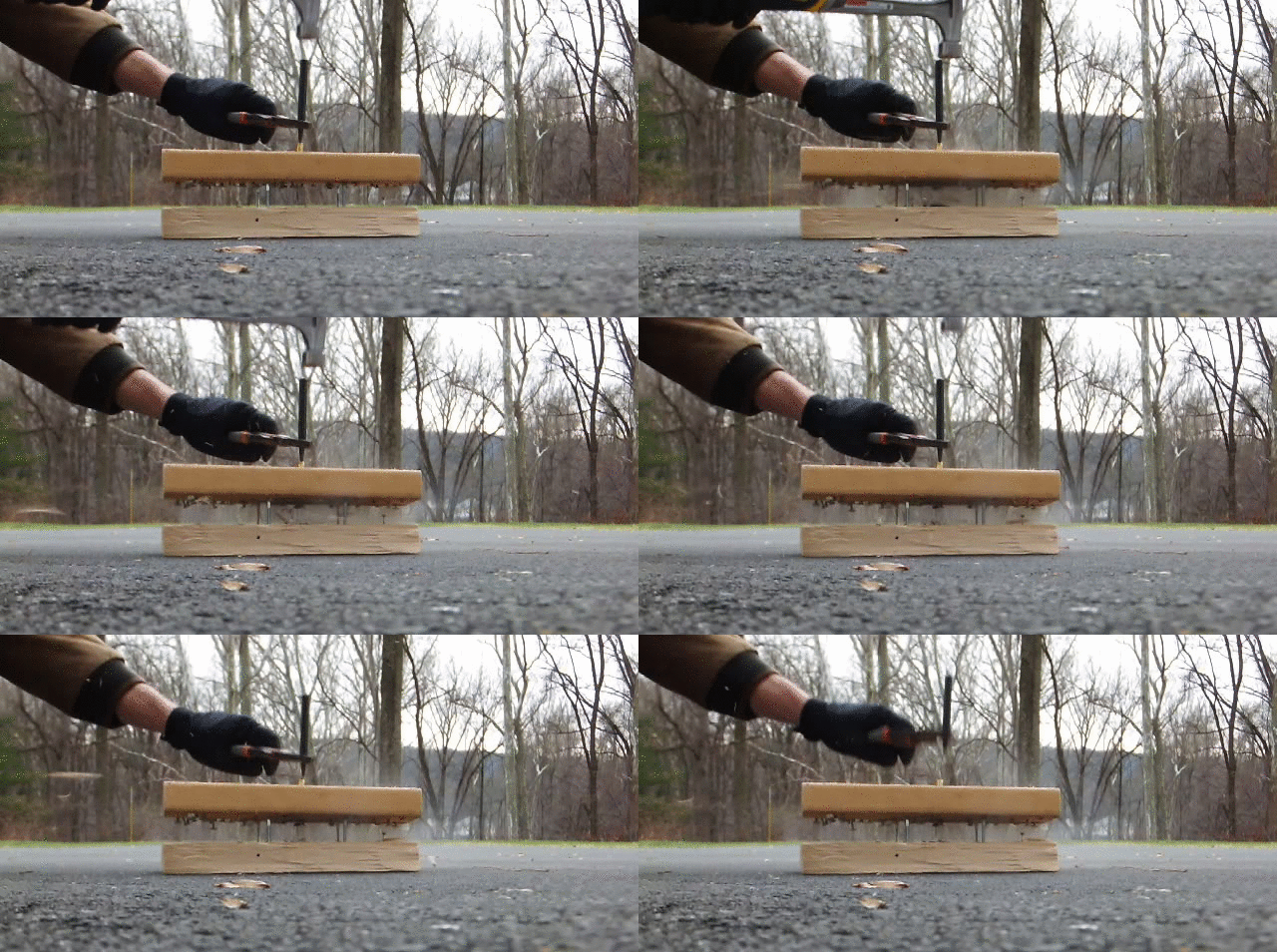
Hand-fired loaded round

This sequence shows me discharging a loaded round I couldn’t disassemble. There is no reason to ever do something like this other than brazen curiosity. If you want to disable a live round you should pull the bullet and dump the powder. If for some reason that fails a safer alternative to discharging it is to “cook it off” in an open pit fire. (Ensure that anyone not wearing a face shield and thick clothing stands clear until it pops.)

Firearm cartridges are not particularly powerful or dangerous unless they are tightly confined. Without a gun barrel to contain and direct the pressure smokeless powder burns slowly, if at all, and bullets are propelled only by the force of the primer. (Granted, primers are not toys. They are true explosives. Small firearm primers produce 5-10 foot-pounds of energy, and can produce pressures on the order of 25kpsi in a small closed chamber. Like firecrackers, they can burn and maim.)

The round I had on my hands contained a full load of powder that turned out to be too fast for the bullet. I managed to pull the rest of the batch, but one bullet came out and left its copper gas check in the case. In that condition it could have been safely fired in a gun, except that it could have badly fouled the bore depending on how the gas check engaged it. So instead I drilled a hole in a piece of wood to tightly hold the case neck, put on leather and a face shield, then detonated the primer with a steel punch.

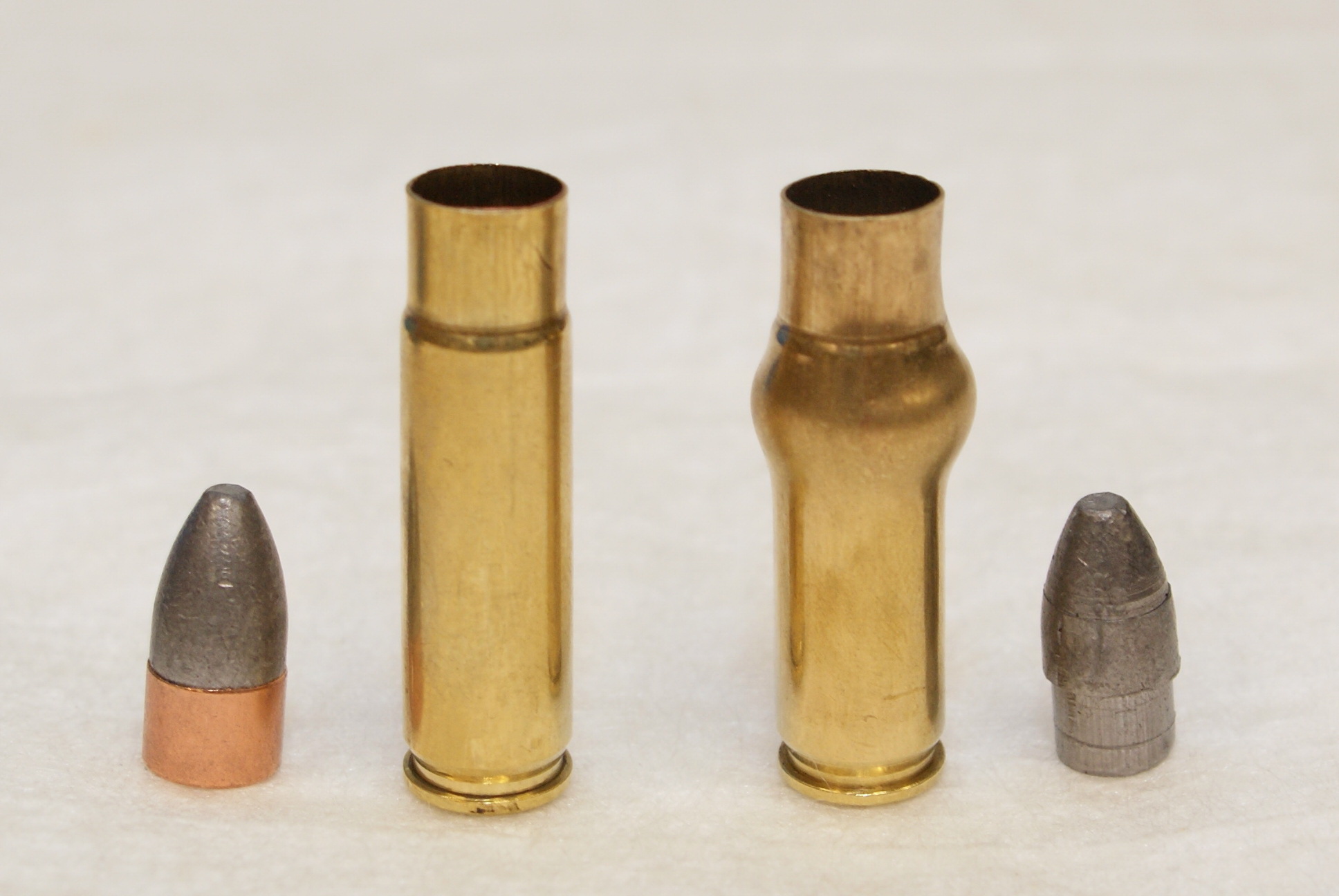
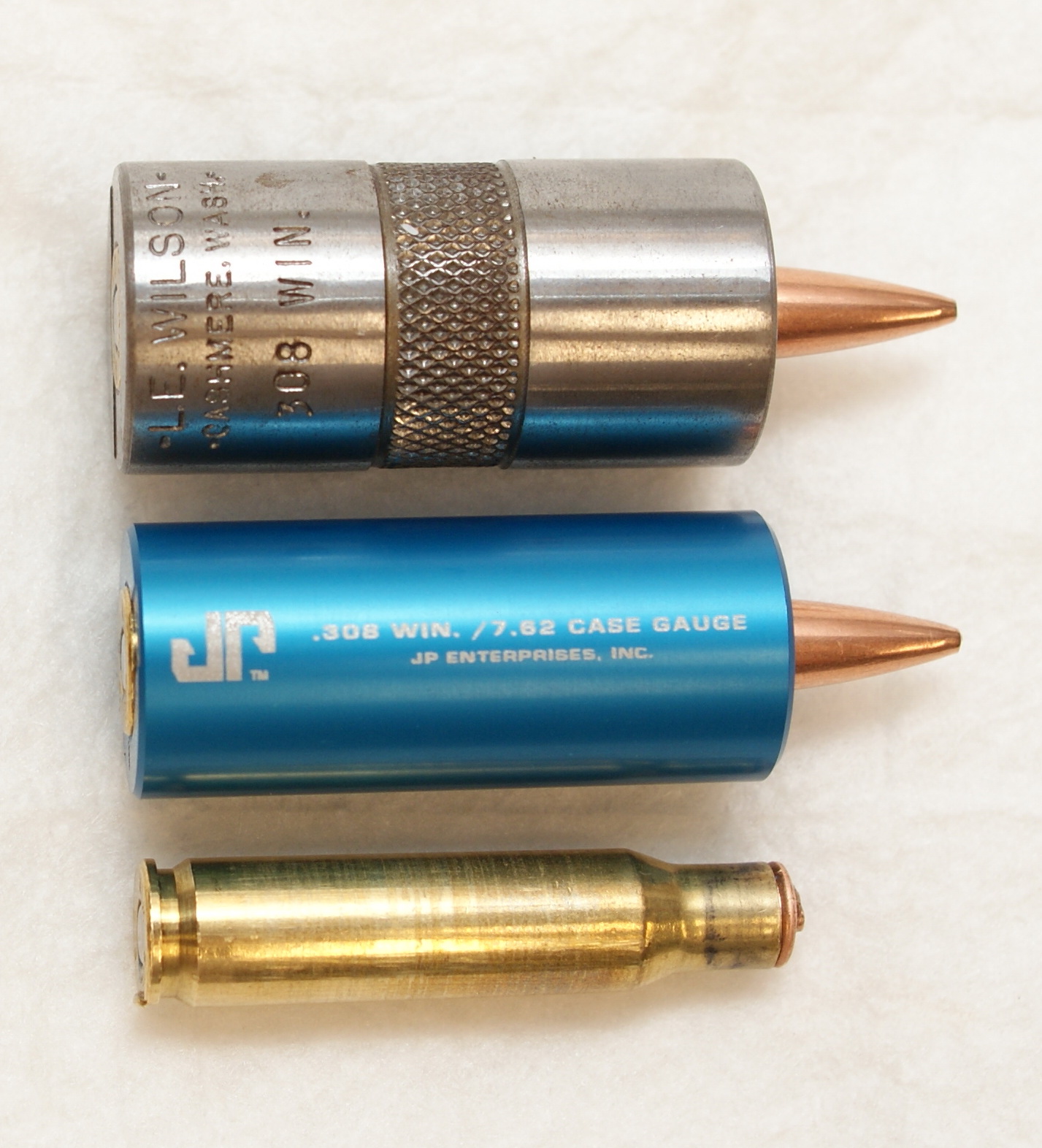
Integral .300BLK case and bullet on the left; hand-fired case and bullet missing gas check on right

An integral pulled bullet and case are shown left. The hand-fired case and bullet missing its gas check are on the right.

The problem with any containment when discharging a round is that without experience and knowledge of the case and powder you may be surprised at where the force ends up. The unsupported case could become a projectile or fail and produce shrapnel. The bullet and any other particles in the path of the venting gases can also be ejected almost anywhere. The setup above was carefully planned to allow for the worst possible outcome in every dimension. What actually happened is that the case neck held fast in its hole in the upper plank and the unsupported annealed upper body was blown out by the pressure, but did not fail. The gas check ended up embedded in the bottom plank directly below, and the gas was able to vent out the gap between the planks, blowing only minor wooden debris along with it.

Products I’m looking for in 2014

Arms

  • Supply in the firearms industry is finally starting to converge on demand. But reloaders are still grasping for powder, and .22LR is still absurdly scarce. We’re looking for both of those shortages to end by the middle of this year.
  • Expanding subsonic rifle bullets: Looks like this is finally the year for these to hit the mainstream market. Outlaw State Bullets and Lehigh Bullets have had some expensive offerings. But this year Norma is supposed to begin importing their Plastic Points, and Remington should finally have an offering tailored for their 300BLK.
  • .38 Supercomp Sig and Glock conversions. The caliber offers the ballistics of .357 Sig in the diameter of 9mm, which translates to more magazine capacity. Also, as a straight-walled cartridge it’s easier to reload.
  • Laser Doppler Anemometers: Solid-state devices for shooters, similar to laser rangefinders, that can measure downrange winds. Winds are the last primary ballistic factor that can’t be measured outside instrumented ranges. Even the most skilled long-range marksmen in the field have limited indicators from which to read and compensate for windage. Admittedly this technology is still some years off from commercialization.
  • Chemical laser guns. Well maybe not this year, but the technology is there for it.

Cars

Video

  • High-speed consumer video cameras: GoPro may be inching back into this niche left by Casio four years ago. Their top offerings can now sustain 240fps at 480p, but I’m still looking for thousands of frames per second in a sub-$1000 camera, which is no stretch given the state of the art.
  • Reasonably-priced HD IP security cameras: For some reason these persist at over $200 when the state of the art should have them closer to $100.
  • Digital thermal and night-vision gear: No manufacturer seems to want to lunge for the tipping point. Equipment that is currently produced at a small scale, and therefore costs 4- or 5-figures, could be profitably mass-produced and sold for 3-figures to the sport and non-military security markets.

Barrett MRAD

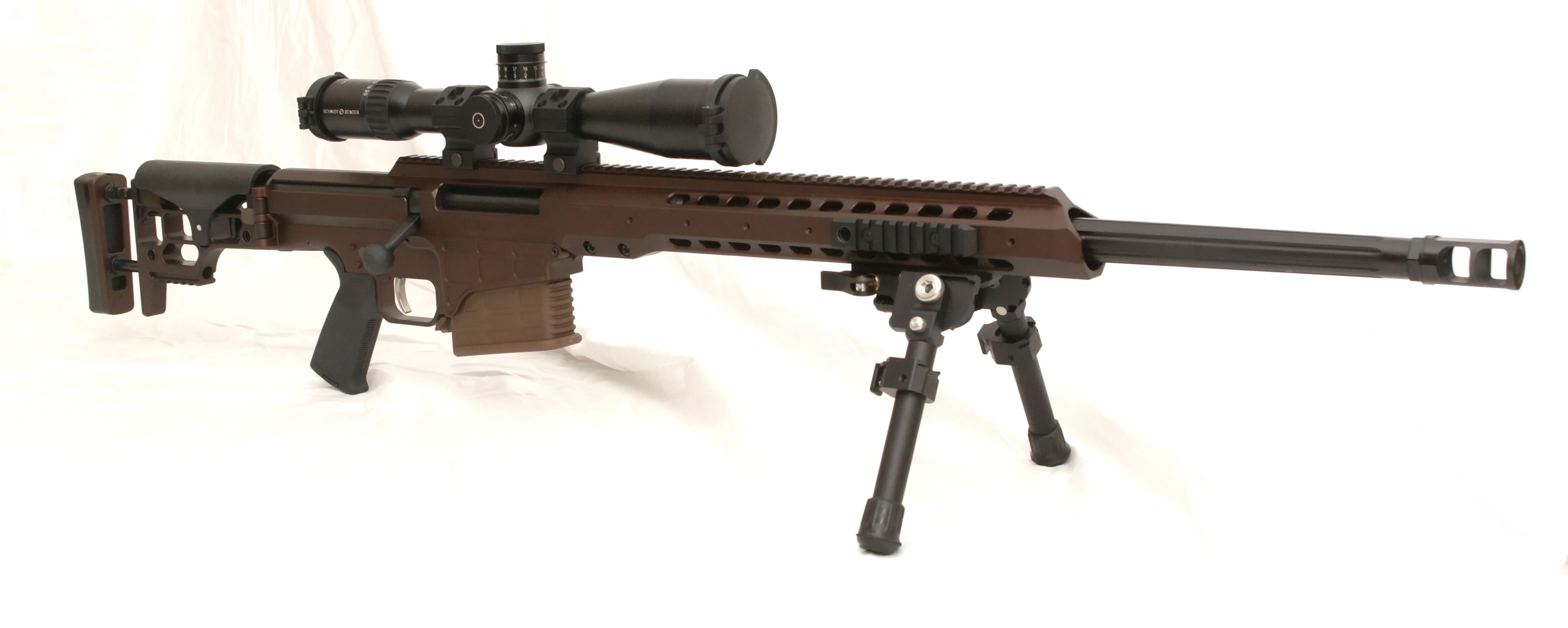
Barrett MRAD

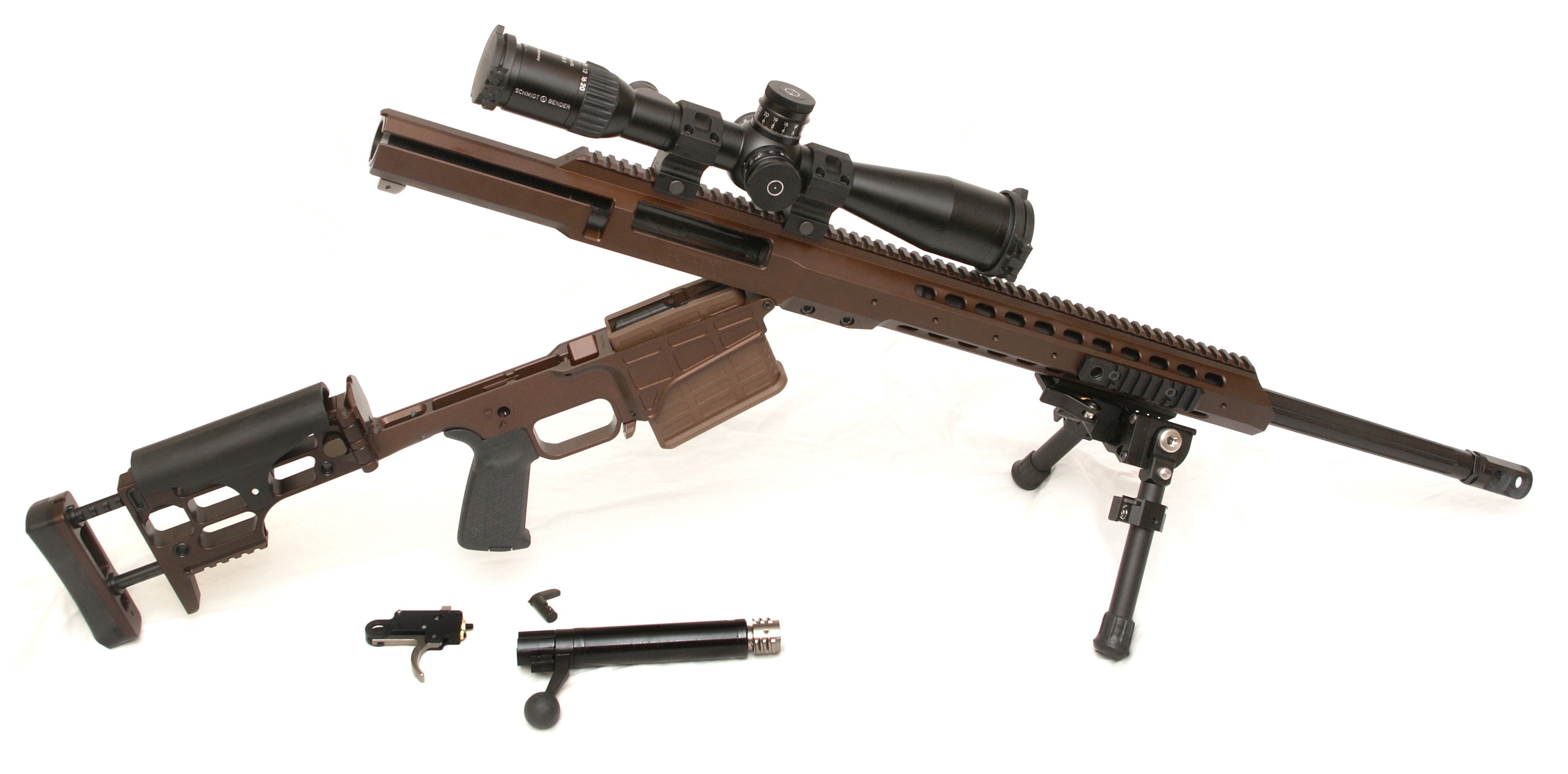
The Barrett MRAD is a $5800 precision multi-caliber bolt-action rifle, shown here with a 24″ barrel in .338 Lapua Magnum, and a $500 quick-detach LRA bipod. The MRAD sets new standards in modularity, simplicity, and compatibility by combining a number of clever design features:

  • Like most modular rifles its folding buttstock locks into place over the bolt handle. It adjusts for length-of-pull with a button, cheek height with a thumbscrew, and features a bottom rail for mounting a monopod.
  • The upper is a beautifully milled if oddly anodized piece of aluminum with 30MOA of cant in the top rail.
  • It uses robust and reasonably priced double-stack injection-molded 10-round magazines. (However they can only hold rounds up to 3.8″ long, which may limit the reloading envelope of heavy VLD bullets.)
  • Upper and lower receivers separate with one lever and one captive drift pin.
  • It accepts standard AR-style grips. It is shown here with a Magpul MOE.
  • It uses a traditional AR-style short-throw safety.
  • The bolt has an automatic self-lubricating dust cover.
  • Its barrel can be rapidly changed out the front after removing two bolts, and reinstalled without losing zero.

Barrett MRAD field strip

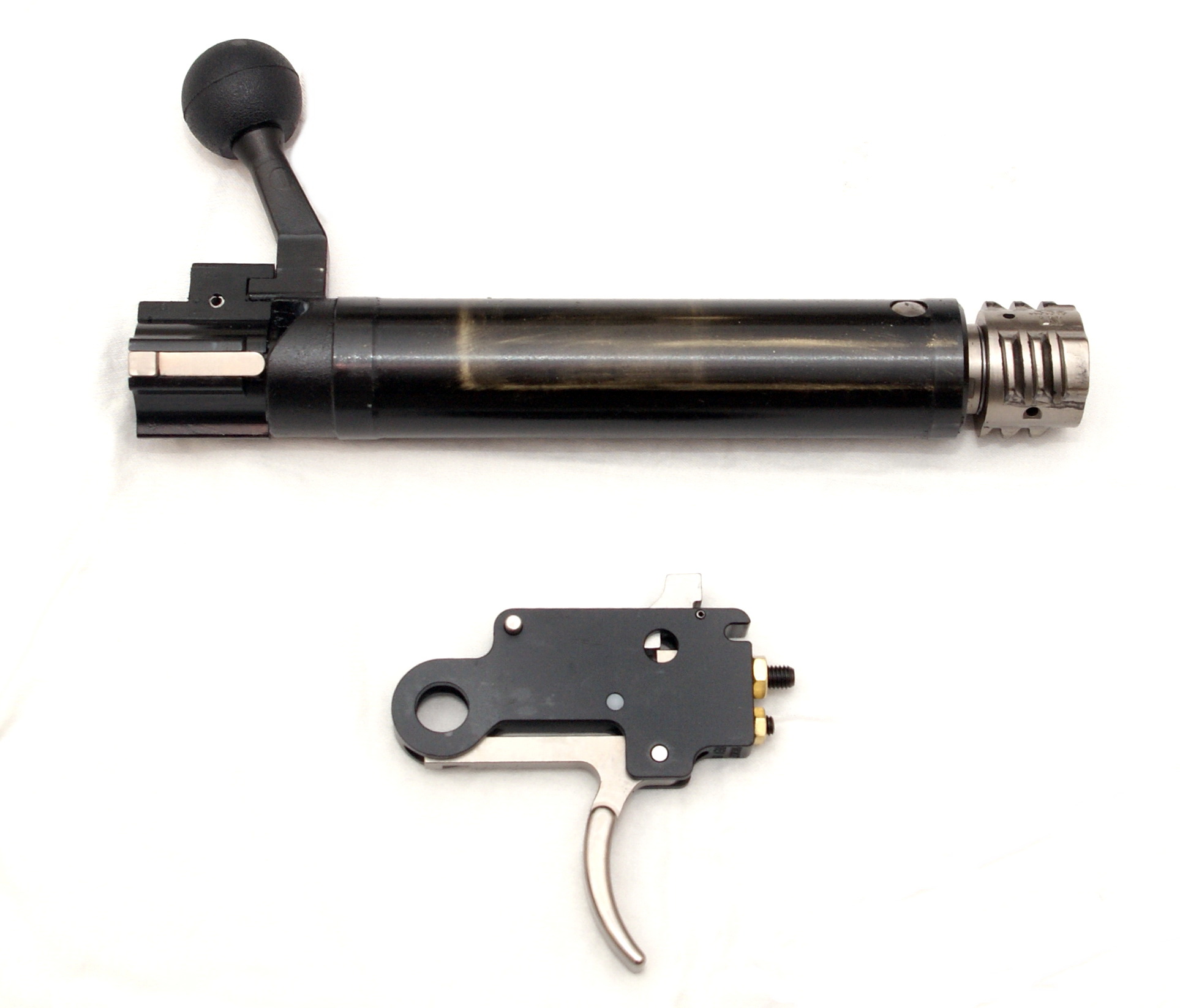
Barrett MRAD trigger groupAfter pivoting the gun open the bolt comes straight out. The safety can be pushed out without tools at which point the trigger module can be lifted out. The trigger itself deserves special attention: It is as simple as can be and elegantly executed. Adjustable down to 1.5 pounds, it breaks shots consistently with no creep or overtravel — an ideal specimen for precision shooting.

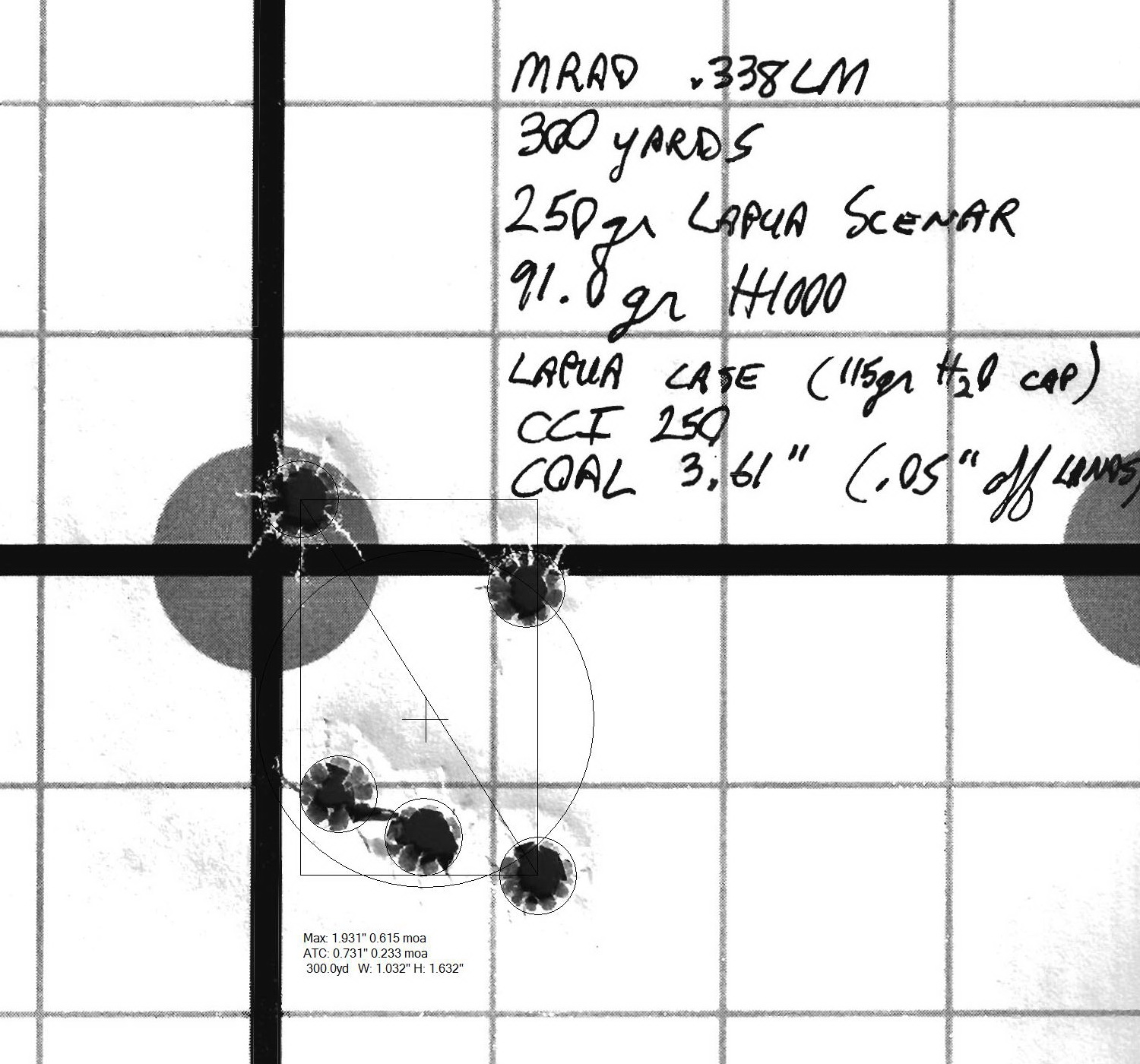
And this rifle is precise! Following is the very first group shot at 300 yards after zeroing at 200 yards. Using my preferred handload with Lapua brass and 250gr Lapua Scenars this 5-shot group is right about 0.6MOA.

Quarter-MOA 5-shot group at 300 yards

As shown the rifle weighs over 17 pounds, so it makes shooting the heavy .338LM quite tolerable. After several years of delays Barrett is just now bringing caliber conversion kits to market for $1500, allowing owners to switch bolt, barrel, and mags to shoot lighter, cheaper .308 or .300WM from the same gun.

The only shortcoming as delivered is that the bolt knob is a cheap piece of injection-molded plastic. Presumably it is meant, like that standard grip, to be replaced by the end user with his preferred bolt handle.

Precision Sniper Rifle (PSR)

In 2008 the US Special Operations Command (SOCOM) began soliciting a new “Precision Sniper Rifle” (PSR) to fill the gap between the .308 M24 and .300WM M2010 (both manufactured by Remington) and the M82/M107 .50BMG rifles (by Barrett). The primary cartridge for the PSR is the .338 Lapua Magnum.

A unique objective of the PSR program was to procure a system that would allow for rapid barrel changes in the field, including conversion to fire the smaller .300WM and .308 calibers using the same chassis and optic. The precision specification was already quite demanding — a consistent vertical spread of no more than 1MOA over a statistically significant number of trials. Constructing a system in which a barrel could be removed from the action in the field and then returned to the same zero may have previously be unthinkable.

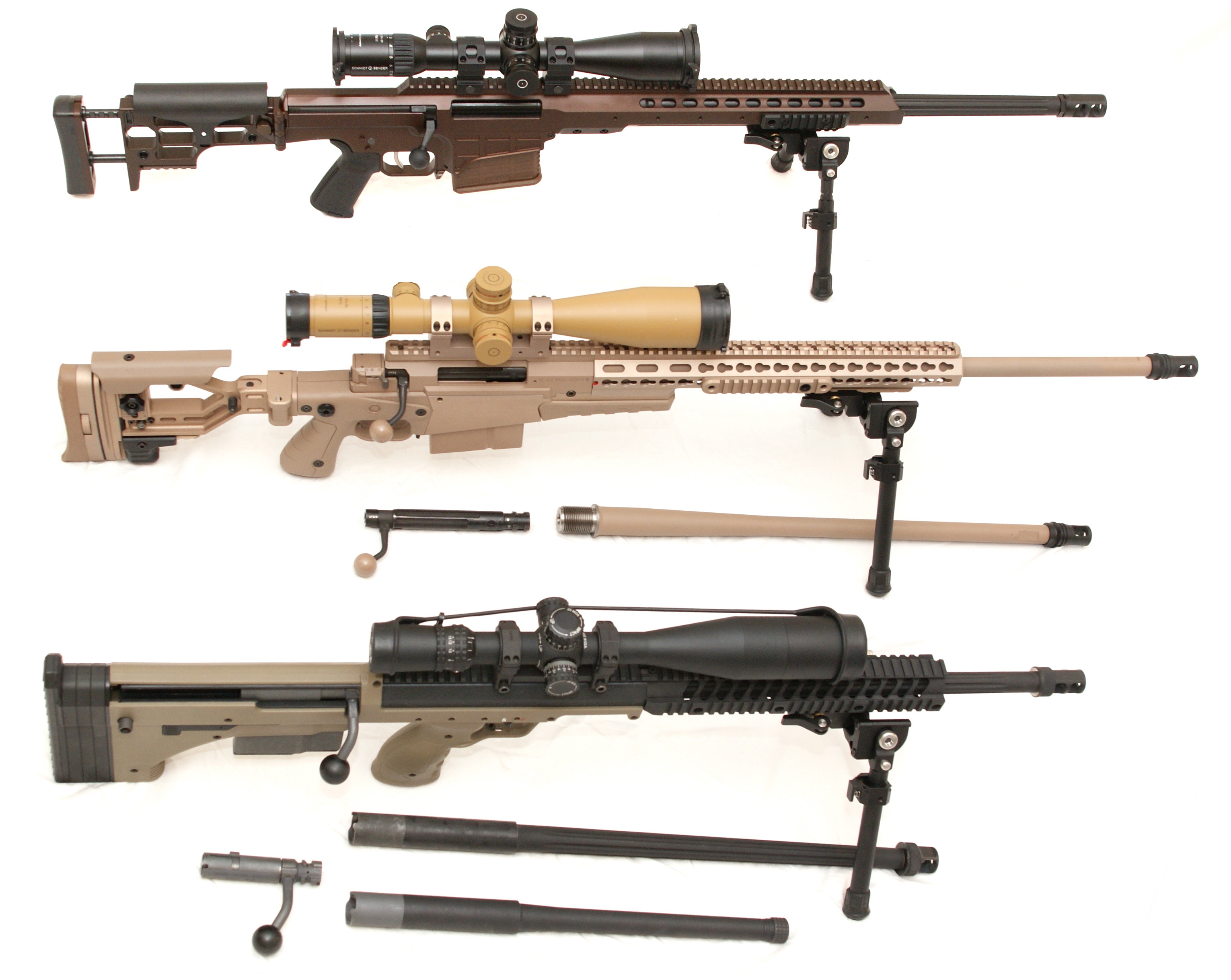
It turns out plenty of civilian shooters were just as interested in owning a multi-caliber precision rifle. Shown here are three that were designed for the PSR program and made available for sale to the civilian market.

Barrett MRAD, AI PSR, DTA SRS

On top is the Barrett MRAD. Initially offered only in .338LM for $6000, Barrett just brought its $1500 conversion kits (bolts, barrels, and magazines) to the market.

In the middle is Accuracy International’s PSR, currently sold only as a complete kit with all three calibers for $17000.

Bottom is the bullpup Desert Tactical Arms SRS, the bargain of the group at $3000 for the chassis and roughly $1500 per caliber kit. We previously reviewed the DTA SRS. Of the multi-caliber PSRs it currently seems to have the greatest market penetration. It is also available in the widest array of calibers, and even has third parties manufacturing conversion barrels.

The PSR contract was finally awarded this March to Remington’s “Modular Sniper Rifle,” which will probably not be available for civilian purchase until government demand has been satisfied.

Military Rifle Cartridges

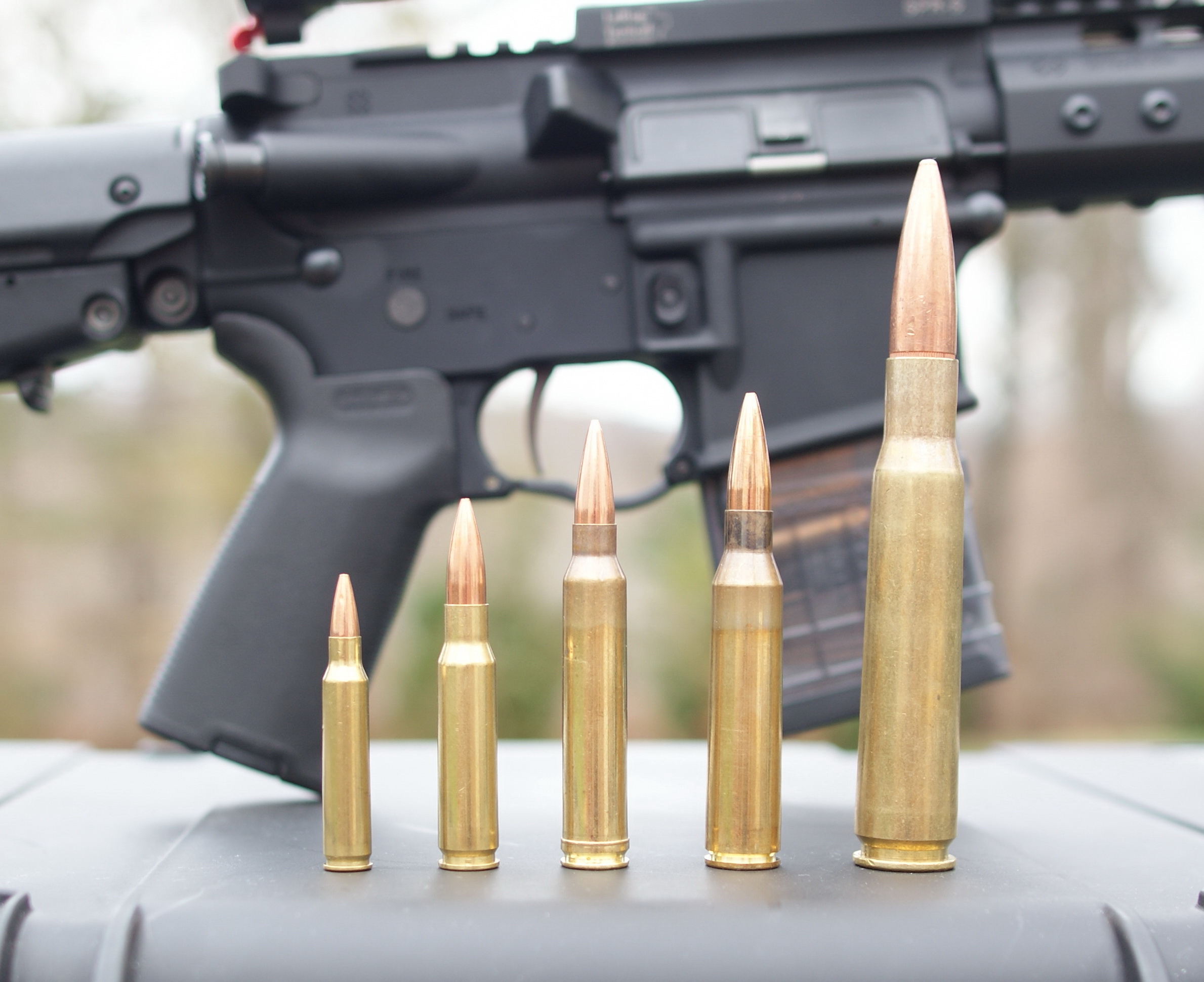
5.56 NATO, 7.62 NATO, .300 Winchester Magnum, .338 Lapua Magnum, .50BMG

These are the rifle cartridges in common use by modern western militaries. The smallest is the standard NATO infantry round, 5.56x45mm. Adjacent on the left is the “medium” 7.62x51mm, also a common infantry round, especially in theaters where longer engagement distances render the 5.56 ineffective. Middle is .300 Winchester Magnum (.300WM), which has long been fielded for snipers needing to push beyond the 1000-yard “effective” range of the 7.62mm NATO. The .300WM is being supplanted by the fourth cartridge, .338 Lapua Magnum (.338LM), which has emerged as the top long-range military sniping cartridge. Previously, long-range snipers often relied on the largest of the “small arms” cartridges: the century-old “heavy” .50 Browning Machine Gun (.50BMG) round.

The following table lists the size, weight, and range of each cartridge for typical military loads, barrels, and sea-level atmospheric pressure. The point at which bullets slow through roughly 1100fps is a common benchmark for range because that is the speed of sound at typical air temperatures. Historically the accurate range of a precise bullet has been limited by the effects of crossing through the sound barrier. However, modern barrels tend towards faster rifling twist rates which increase transonic stability. In the last decade snipers have recorded first-shot kills at ranges where their bullets were subsonic. Snipers at high altitudes have made a number of remarkable kills at distances of up to 2700yds. The thinner air at high altitudes creates less drag on bullets and thus extends their range.

Caliber Cartridge Weight Length Bullet Energy at 1100fps Standard Barrel Muzzle Velocity Range to 1100fps
5.56mm
NATO
MK318 Mod 0 180gr   2.26″   62gr OTM 170 ft-lbs   14″ (M4A1) 2925fps   730 yds  
20″ (M16A2) 3130fps   780 yds  
7.62mm
NATO
M118LR 400gr   2.80″   175gr OTM 475 ft-lbs   20″ (M110) 2570fps   970 yds  
24″ (M24A1) 2640fps   1000 yds  
.300WM MK248 Mod 1 490gr   3.50″   220gr OTM 600 ft-lbs   24″ (M24A2) 2850fps   1400 yds  
.338LM 680gr   3.68″   250gr 680 ft-lbs   27″ 3000fps   1525 yds  
730gr   3.85″   300gr 820 ft-lbs   2800fps   1700 yds  
.50BMG M1022 1750gr  5.45″   650gr 1780 ft-lbs   29″ (M107) 2750fps   1500 yds  

On the heavy end it’s interesting to see that the .50BMG is actually at a disadvantage to .338LM in terms of range (not to mention the added weight of the rounds and heavier guns needed to efficiently shoot it). But it does have the capability of delivering more than double the payload, so it is still in use for anti-materiel roles.

Continue reading

Clarification on Ultralight Bullet Ballistics

If you’ve read some of the recent articles on ballistics, especially the comments on this one, you might logically deduce that for any gun the best bullet is the lightest you can find. After all, lighter bullets produce less recoil and more muzzle energy. How can you lose?

It turns out a number of companies have come and gone trying to exploit this argument to sell extremely light, fast bullets, especially for handguns. Liberty Ammunition is the latest on the scene. A detailed critique of previous ventures that includes extensive explanation of the problem with ultralight bullets is archived here.

The short answer is that very light bullets are very bad for defensive use because they lack penetration, and companies that sell them for that purpose are guilty of misleading advertising. Yes, at short ranges they “dump” more kinetic energy into targets, but that energy does not create the deep wound channels experts know are necessary to physiologically stop aggressive animals (including people) in typical shooting scenarios. That’s the end of the argument as far as consumers are concerned.

I will make two other esoteric observations: First is that on the low end ballistic efficiency decreases with bullet weight. The second is that sectional density decreases with weight, which means that ultralight bullets lose speed (and energy) faster and are more susceptible to deflection in flight.

So ultralights suffer impairments at every stage of ballistic consideration: internal, external, and terminal. At short range their extraordinarily high velocity does enhance penetration through some materials, but that does not mitigate their drawbacks. If you have a specific scenario that requires penetration you should get a rifle and load suited to it. Never load your defensive handgun with ultralight bullets!

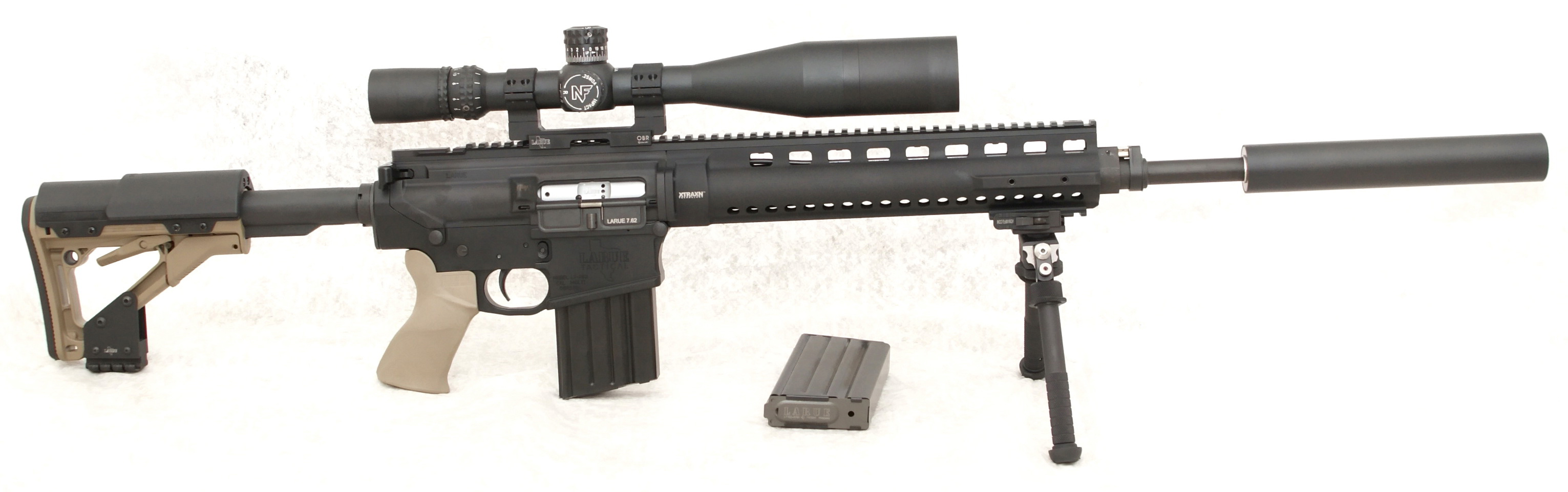
LaRue Tactical Optimized Battle Rifle (OBR)

LaRue Tactical Optimized Battle Rifle (OBR)

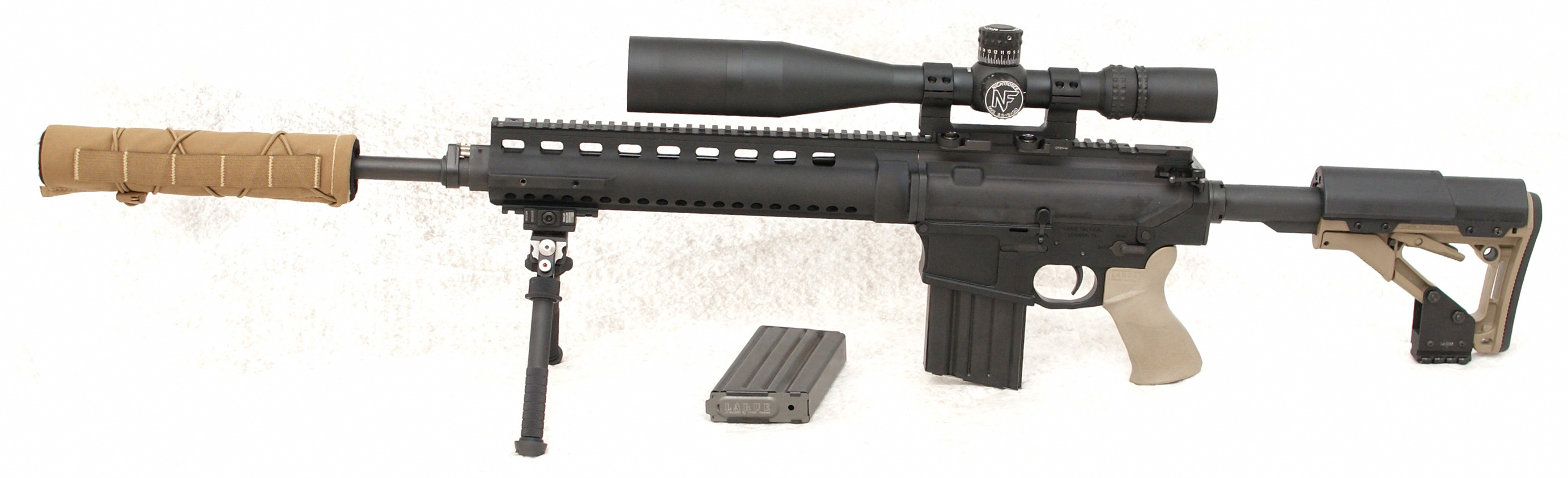
The LaRue OBR represents the pinnacle of autoloading medium-caliber rifles. It’s not the only premium AR-10-pattern gun on the market, but it’s probably the best deal. The base rifle is just over $3000 … plus a wait currently running about eight months. Fit and finish on this hand-built gun is superlative. In fact, the tolerance between the upper and lower was so tight I had to use a rubber mallet to separate them at the rear takedown pin.

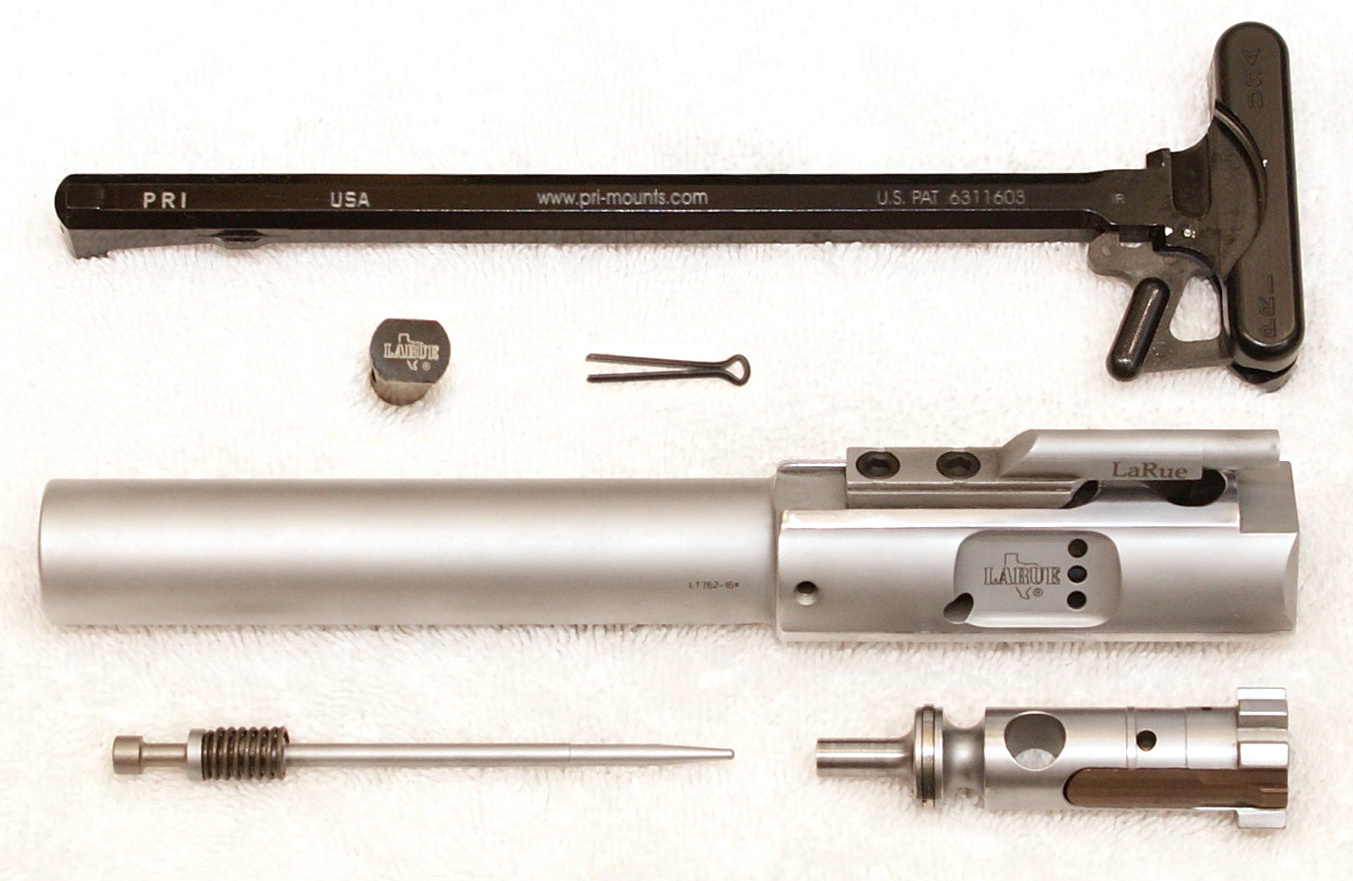
The 18″ .308 caliber model here has been kitted up with LaRue’s quick-detach scope mount ($264), a $2200 Nightforce F1 NXS scope, Atlas QD bipod ($280), and $1250 Thunder Beast 30BA suppressor. Suppressor compatibility is one of the great features of this gun: It has a port selector on the gas block that toggles to the right to reduce blowback when shooting with a suppressor. And, since even that won’t prevent carbon fouling of the action, most of the BCG has a polished chrome finish that wipes clean — shown here cleaned after its first extended range session:

LaRue Tactical OBR BCG

The rifle comes with two of LaRue’s M110 20-round magazines, which are slicked-up boxes with a fully-welded seam in the rear to maximize loadable cartridge length. Additional LaRue mags run $75/apiece.

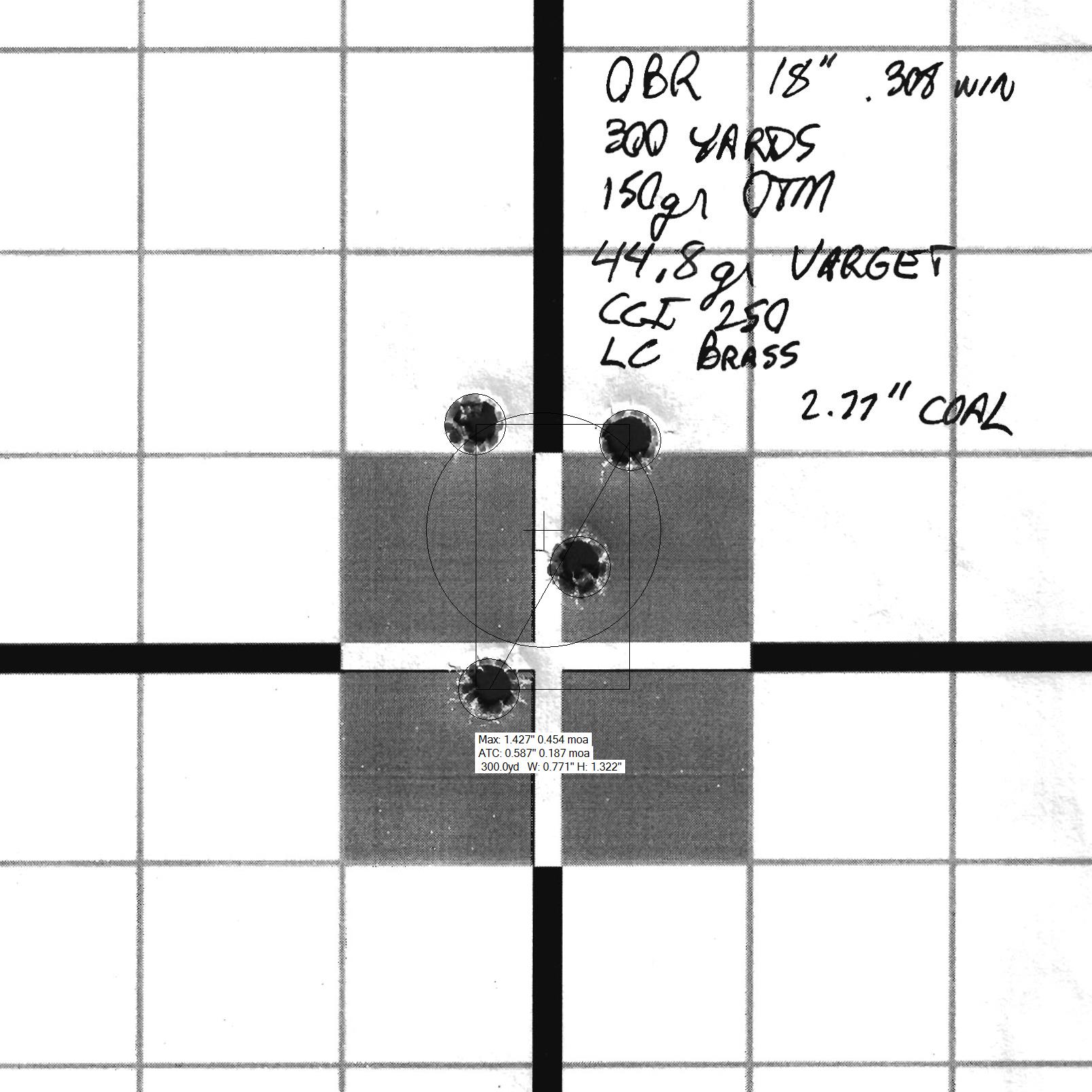
A couple of sons joined us for the rifle’s inauguration. After we sighted in at 200 yards a 90-pound 12-year-old with little experience was able to get behind it and ring two 10-inch swinging plates, alternating back and forth with no hesitation, for a full magazine. It was an impressive feat. Before moving to more distant steel I jumped on it and took the first four shots at 300 yards with my 150gr handload optimized for 18″ barrels:

OBR 4-round group at 300 yards: 1/2 MOA

With both 168gr FGMM and this handload the rifle is easily a 1/2 MOA gun. Update: Further testing at 100 yards using state-of-the-art statistics show its CEP is under 0.4MOA.

The trigger is a crisp Geissele SSA two-stage, with about two pounds on each stage. When given the choice I opt for single-stage triggers, but on a rifle designed for the most grueling field conditions I can agree that a two-stage offers an extra layer of control while still allowing for the precision of a light pull.

LaRue Tactical OBR with Nightforce F1 NXS and TBAC 30BA

AR-15 Lower Build

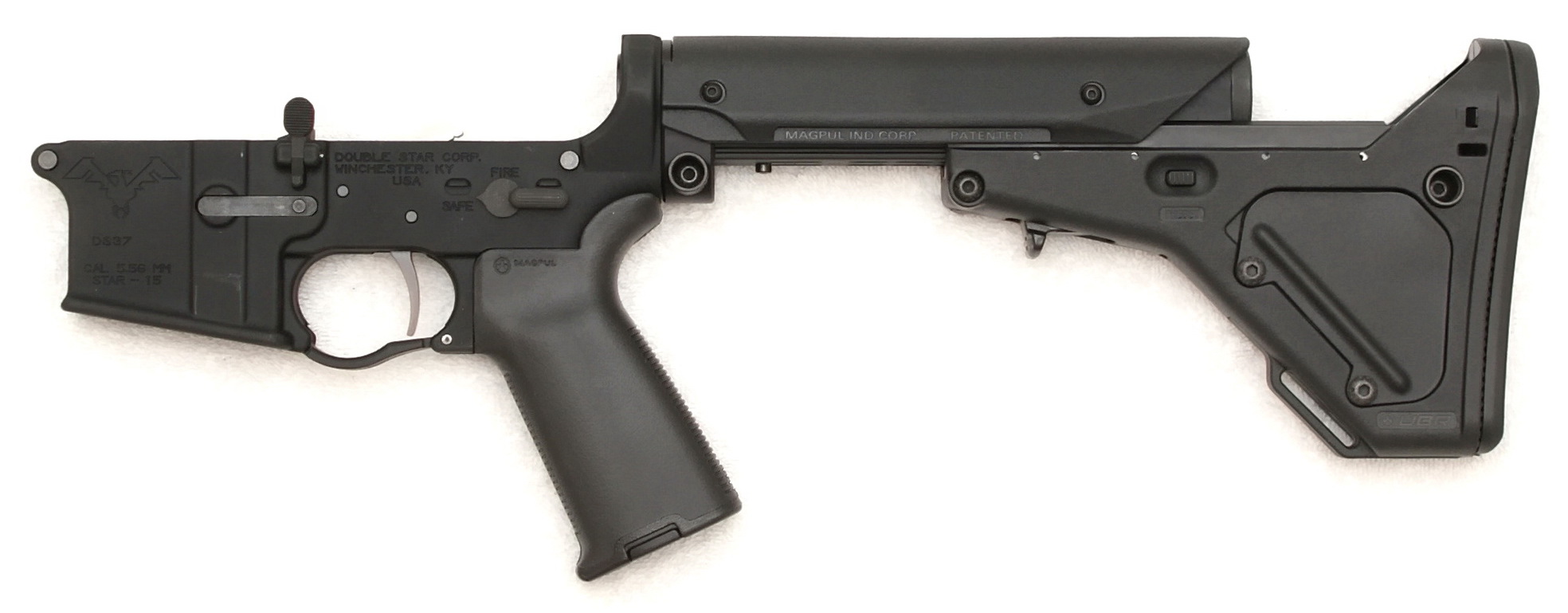
After I bought a Noveske upper I decided it deserved its own lower, and in order to get exactly what I wanted I chose to build this one myself. The finished lower shown above started out as this $700 collection of parts:

Going roughly clockwise from the bottom these are:

  • $100 Double Star stripped lower + $25 dealer transfer fee
  • $20 Magpul MOE+ grip
  • $240 Magpul UBR stock
  • $160 Timney 667S 3.5lb single-stage trigger
  • $125 JPSCS-15 Silent Spring System
  • $20 Brownells lower parts kit
  • $16 Troy Enhanced Trigger Guard

The actual assembly took me perhaps two hours, and that’s without any special tools that can make inserting some of those springs and pins a lot easier. There are several decent online guides for the process.

The stripped lower is the only serialized part, and so the only thing that has to be purchased through a licensed gun dealer. (It’s kind of funny doing the paperwork to buy a “rifle” and walking out with nothing but a small block of metal.) I was lucky to have ordered this lower last November just before the double-bubble in demand that is only now subsiding. The brand doesn’t really matter: A standard AR-15 lower is machined from forged aluminum and is hard anodized black. There are only a few variations that one needs to be aware of to ensure parts compatibility: trigger pin and buffer tube size (military or commercial), and safety throw (standard or short).

The biggest splurge on this lower is the UBR stock: It’s Magpul’s top-of-the-line telescoping stock, and unlike any other it is rock solid with zero movement or rattle at any extension. I also paid up for the JP Enterprises Silent recoil spring system because I was building this lower for an often-suppressed upper, and even when I shoot unsuppressed I usually wear electronic ear muffs. I find the rasping, twanging noise that accompanies many AR-15 recoil springs’ cycles annoying. Not all of them make it — for some reason the spring on my SR-556 is silent — but I didn’t want to leave this one to luck. The other advantage of the self-contained JP system is that it doesn’t require a retainer detent: I omitted that from the receiver so the one-piece buffer/spring assembly can easily be installed and removed.

I’m a stickler for triggers — a light, crisp trigger is essential to wringing all of the accuracy potential out of a gun. I have and like a Chip McCormick drop-in, but I prefer the retention mechanism on this otherwise functionally indistinguishable Timney unit: The CMC trigger requires special pins that secure with external C-clips. The Timney uses the standard trigger-group pins and is retained by tightening screws that press the body up against the pins.

There is a diverse market in grips for AR-15s. Since I have large hands I go for larger grips. I also stick to grips with an integral backstrap to avoid any pinching in the otherwise exposed joint between the grip and the receiver’s back radius where the firing hand web anchors itself. I like the tacky rubber on my Hogue grip, but it doesn’t have a backstrap and, like comparable Ergo grips I have tried, its core has some flexibility that I don’t want when I have to move the rifle by the grip. The MOE+ delivers that soft rubber finish with the rigidity I was looking for. I would like it more if it had the stippled style of the Hogue instead of the front and rear grooves that work better on hard plastic.

Rethinking Direct Impingement with the Noveske 300 BLK Upper

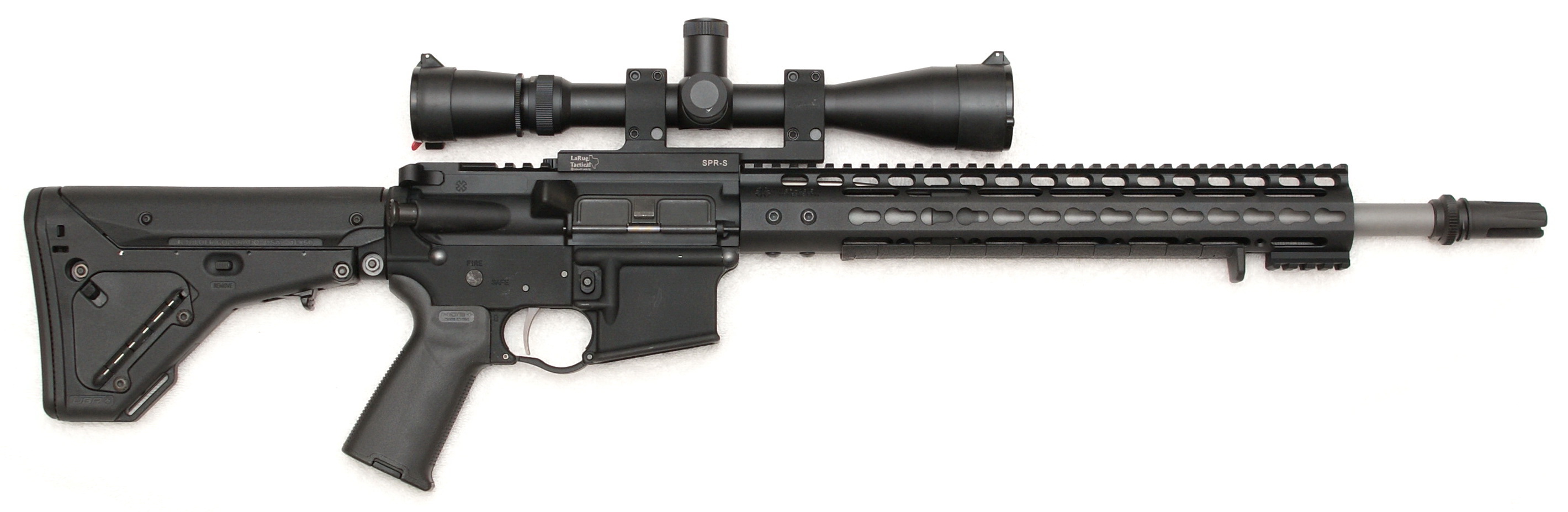
Pictured here is an AR-15 with a $1150 Noveske Rogue Hunter Upper chambered in 300 BLK. I bought the upper from a friend the first time we took it to the range. He didn’t think it justified adding another caliber to his collection; I fell in love with it. It has a pistol-length (very short) gas tube so it reliably cycles any load, even without a suppressor. It has a stunning stainless steel barrel with 1:7 polygonal rifling, sheathed in Noveske’s NSR KeyMod handguard. After years of work with piston rifles I guess I had forgotten the virtues of DI guns: This is so light, so accurate and, with a suppressor shooting subsonic rounds, so quiet!

My first review of an AR-15 criticized its direct gas impingement (DI) action for causing unnecessary fouling and heating in the receiver. Since I like to keep guns in mint condition, scrubbing and scraping baked-on carbon fouling from the action after every range trip became a dealbreaker: That AR-15 is one of the few guns I have ever sold as I moved my collection of autoloading rifles to what I considered to be superior piston-based actions. I have since realized the situation isn’t so simple.

One technical clarification is in order: The standard AR-15 action is not really “direct impingement.” Eugene Stoner took pains to clarify that in his patent on it, characterizing it instead as a gas piston system with the operating rod cleverly replaced by an expansion chamber on the bolt carrier itself. Nevertheless, to aid discussion and follow tradition I will continue to refer to the Stoner action as “direct impingement” (DI) and reserve “piston” for actions with op rods.

After years of testing piston rifles with suppressors I have learned that no matter how you restrict the gas flow on a conventional autoloader you can’t keep fouling out of the receiver. Suppressors hold more backpressure over a much longer period than an open muzzle, which results in a lot more blowback through the chamber when the action unlocks and ejects the fired case. You can actually see the blowback out of the ejection port in this remarkable photo by Oleg Volk:

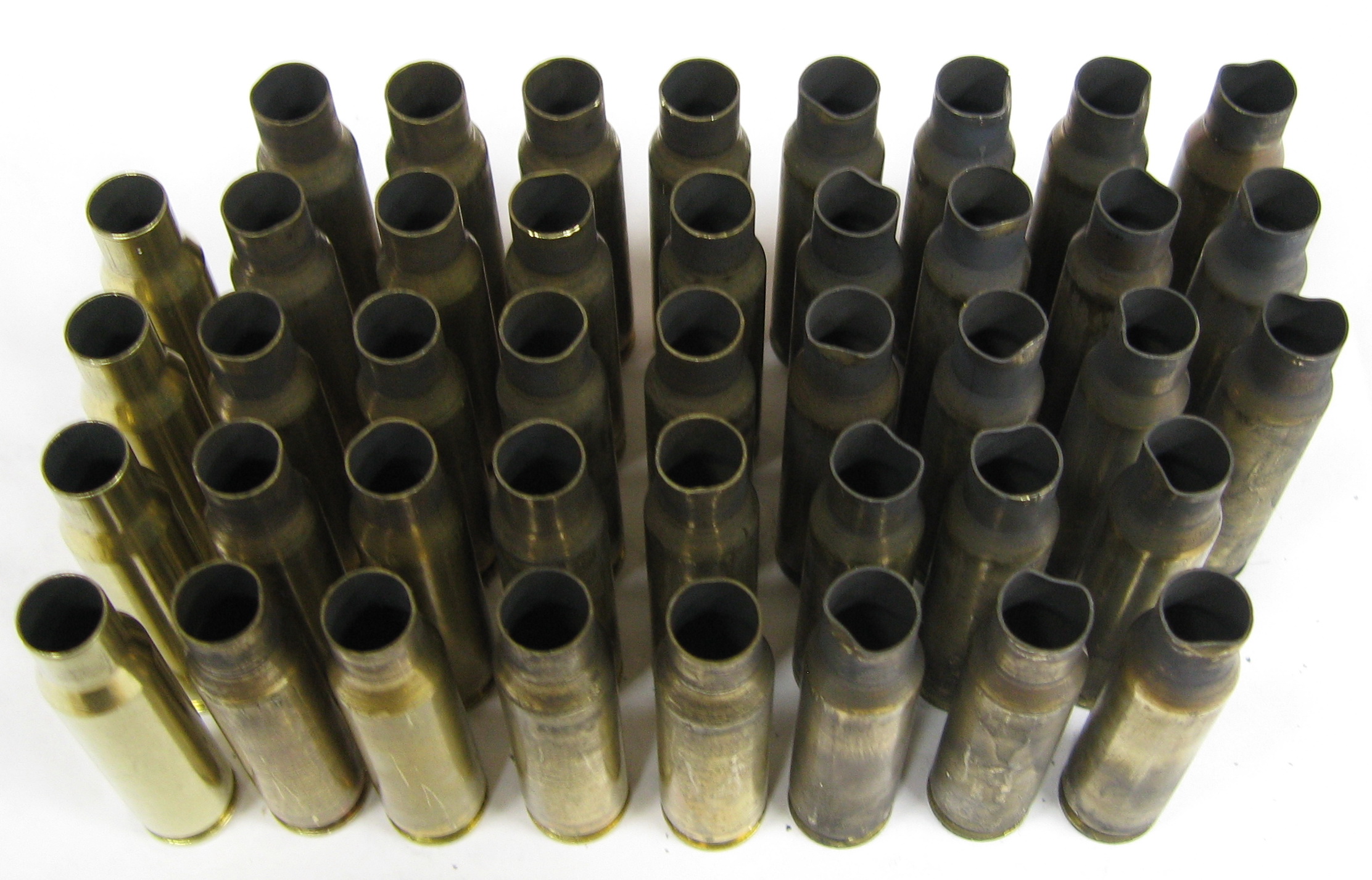
You can also see evidence of the difference on these .308 cases:

The ones on the left were shot without a suppressor, and the ones on the right with a suppressor. The same carbon you can see covering those cases fills the receiver, fouling it as badly as a DI action.

Piston guns still retain their other fundamental advantage over DI guns, which is that the action stays cool (though the forward piston blocks get scaldingly hot). But as I noted in my last post, advanced coatings can also help to make either easier to clean.

Firearm Action Coatings

AR-15 bolts: Parkerized, NiB, Chrome, NP3

Most firearm action components are made of steel, but they can be given a variety of coatings with remarkable properties. Shown here are four AR-15 bolt-carrier groups (BCGs). From top to bottom they are coated in:

  • Phosphate, a.k.a., parkerized
  • Nickel-boron, a.k.a. NiB
  • Chrome
  • Nickel-Teflon, a.k.a. NP3

Phosphate

Phosphated steel has been used in guns for over a century, and is still the military standard for BCGs. The one shown here is from a premium Noveske rifle. I asked Noveske why they don’t use a more modern coating and was told, “Even though the smooth hard coatings take a few seconds less to clean they do not hold oil. Oil keeps the gun running longer and keeps the gun from wearing out. The standard parkerizing holds on to oil longer than any other finish. It keeps the gun running longer.” Indeed, the finish on this BCG is rough and soaks up lubricant like a sponge, though it also seems like a magnet for grit and fouling.

Chrome

Chrome is widely used in barrels and chambers because it is extremely hard, corrosion resistant, and smooth. I’ve run the one shown here from a Ruger SR-556 more than any other single AR-15. It is easier to clean and requires less lubricant than a standard BCG. I suspect it should also be less prone to failures if insufficiently lubricated.

Nickel-Teflon

NP3 is a relatively soft coating of Teflon-impregnated nickel done by ROBAR. Due to its softness it will show wear, but due to its lubricity I am not aware of any instances of it wearing through. It is so slippery that any fouling can be wiped off with a dry rag. The BCG here is from a Barrett Rec7. Wilson Custom also uses NP3 on all their BCGs.

Nickel-boron

The industry leader in NiB coatings for firearms is WMD Guns, which markets the coating as NiB-X, and which spun off from FAILZERO, which markets it as EXO. Shown here is a new $200 mil-spec NiB-X BCG.

Both NP3 and NiB are lubricious enough to run without lubricants. (In fact, like dirt, lubricants can’t really adhere to these electroless nickel-based coatings.) ROBAR claims that NP3 is more consistently lubricious than NiB and significantly more corrosion resistant. NiB is hard enough that you can use steel scrapers and brushes to clean it. However it is not as smooth as NP3 or chrome, so you need a lot more than a cloth to remove the discoloration of carbon fouling that embeds itself in NiB’s microscopic surface irregularities. Granted, that’s a cosmetic issue, not a functional one. It does, however, lend plausibility to a few reports of NiB BCGs jamming up and needing lubricant to unlock.
Continue reading