Future Firearms: From Ballistic to Optical

Those who study the art of precision shooting know that today a good marksman will easily spend 5 figures on equipment, thousands of hours of practice and development, and at least a dollar per shot. All this with the singular objective of being able to project a few kilojoules of energy up to a mile or so away as quickly and accurately as possible.

Today the tool of the trade is the rifle: essentially a tube that converts chemical energy from a gunpowder-fueled cartridge into the kinetic energy of a spin-stabilized bullet. Riflemen go to great lengths to maximize how precisely they can get this machine to project a bullet into the atmosphere. But under field conditions accuracy is limited to about half a minute of arc (i.e., half an inch of error per 100 yards distance from a target). The physics of atmospheric ballistics require heavier equipment to reach further distances, and put the outer limit of a man-portable rifle’s range at about 1.5 miles.

Thanks to evolutionary advances in optics, ballistics, firearms, and cartridges, the capabilities of riflemen have never been greater. But the whole art seems somewhat archaic.

In time precision rifles will go the way of blackpowder muskets, replaced, I suspect, by optical firearms. This may at first sound like trite science fiction — am I seriously writing about the advent of rayguns? Well yes, but consider how and why this wouldn’t be as revolutionary as it sounds: The first optical firearms will probably fire chemical lasers.

Current single-shot chemical lasers are roughly 30% efficient at converting chemical energy into optical energy. They require supersonic mixing of reagents and generate a lot of heat. Current rifles are also about 30% efficient at converting the chemical energy of smokeless powder into supersonic kinetic energy, and also generate a lot of heat. From this point on optical firearms take the lead: A ballistic projectile begins to lose energy and accuracy due to atmospheric interactions from the moment it leaves the barrel. Optical energy follows a line of sight at the speed of light and loses energy only to the degree that its wavelength is dispersed by the atmosphere through which it travels.

Chemical laser firearms could be similar to current rifles in many ways. They will probably employ a single cartridge per shot containing not only the chemical reagents but also an explosive “primer” to mix them when fired. Instead of projecting a bullet into a rifled barrel for acceleration, the cartridge will project the mixture into an optical cavity where mirrors and lenses will focus the flash of high-powered light out the muzzle. Depending on the particular technology the reagents may leave the gun like a muzzle blast, or stay in the cartridge for ejection. Optical cartridges could be reloadable by shooters, just like ballistic cartridges.

So where’s the sport in that? If you can see it you can put a hole in it? As now, a lot of the critical cartridge development will be done by professional chemists at propellant manufacturers. Gun makers will be mostly replaced with the manufacturers who are already making the rugged, precision glass for 4-figure riflescopes. Perhaps marksmen will switch their focus to tricks for pushing the diffraction limit with man-portable optics to further range and accuracy?
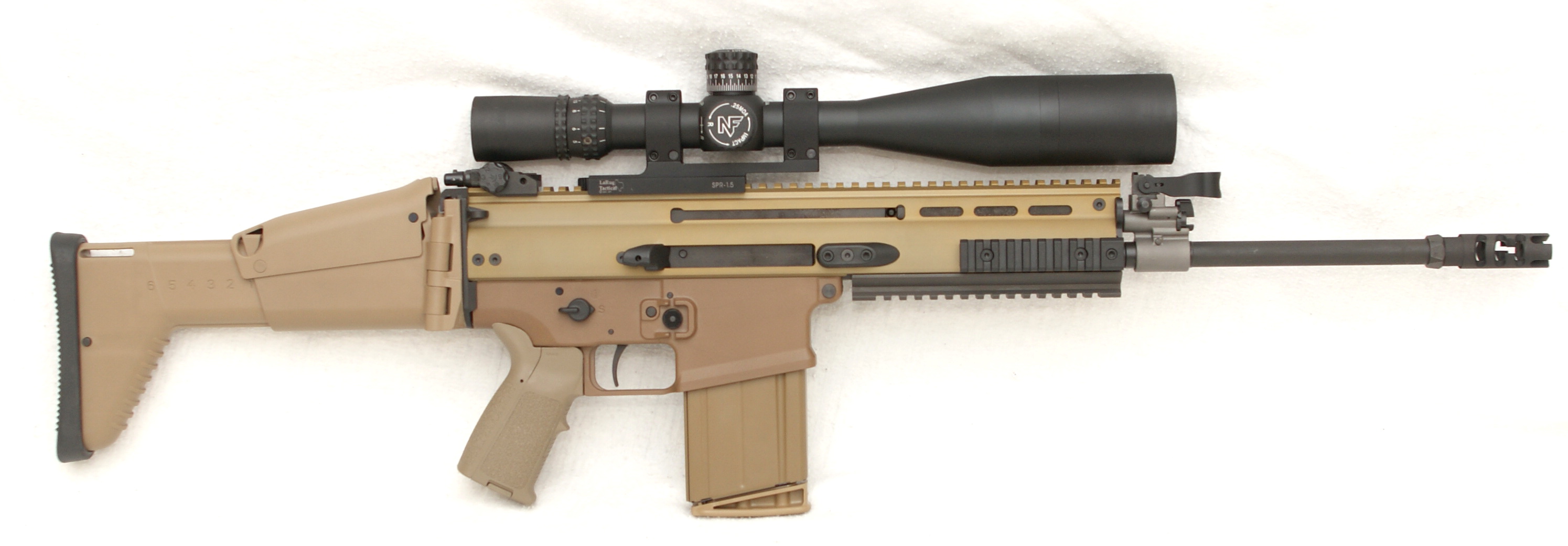
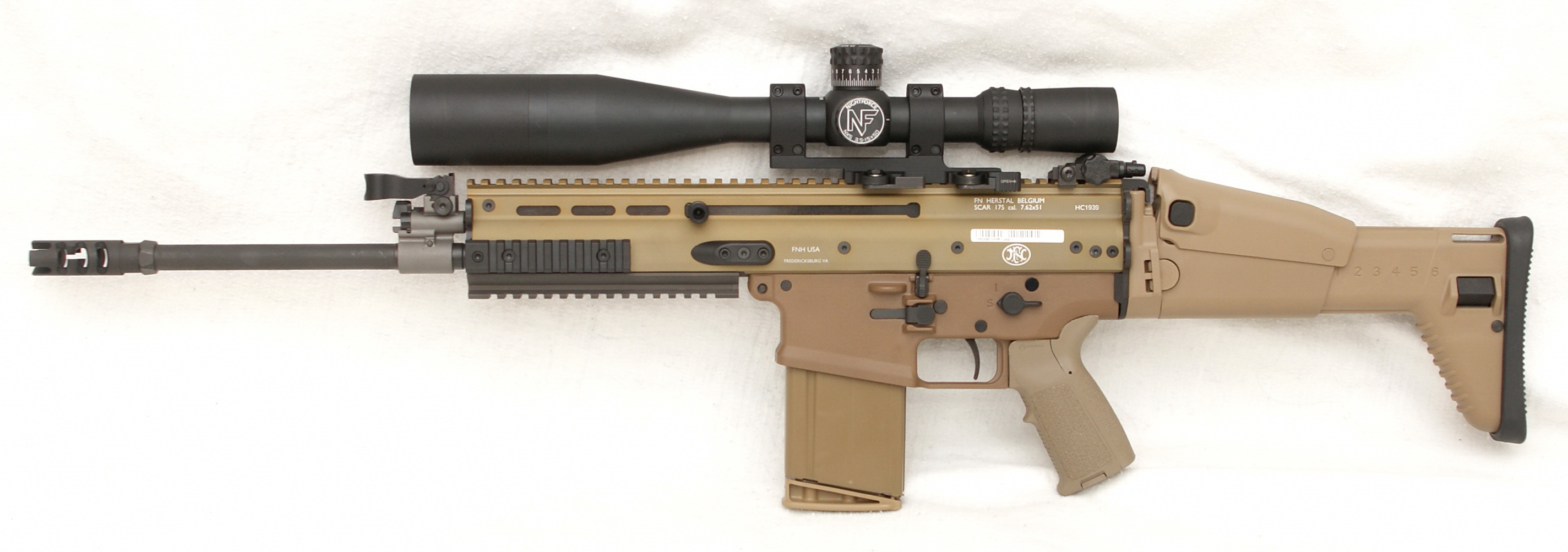
SCAR 17S

SCAR 17S FDE with MIAD grip and Nightforce 3-15x40mm scope

After spending some time with this SCAR 17S I have a few salient observations. If you’re looking for a complete review start here or here.

Overall the FN SCAR 17S is an overpriced but good 4th-generation “heavy” tactical rifle. SCAR stands for Spec-ops Combat Assault Rifle, a procurement project developed by US SOCOM almost a decade ago that ultimately resulted in a production contract for FNH. The 17S is a semi-automatic version of the reliable SCAR-H being produced for the military. “Heavy” refers to the rifle’s caliber, not its weight: At 8 pounds it’s actually quite light for an auto-loader that shoots the mid-power 7.62x51mm NATO round.

Typically this combination of a light gun shooting heavy rounds is a recipe for jarring recoil that makes fast follow-up shots impossible. But the SCAR 17S does a remarkable job taming recoil: In addition to a very effective muzzle brake its massive reciprocating action has been tuned to dampen the recoil impulse to such a degree that it can be fired accurately as fast as a 5.56mm carbine.

Like most 4th-gen tactical rifles the SCAR has a piston action, monolithic upper, folding stock, short-throw safety, and ambidextrous controls (except, strangely, for the bolt catch). It can be field-stripped without tools. Barrels can be changed out with a torque wrench.

Many of my complaints about this gun are based on its price: Almost $3000. This puts it in the realm of custom-tuned AR-10 rifles which, though heavier and lacking in 4th-generation features, are capable of far greater accuracy. Out of the box the SCAR 17S comes with a trigger that is absolutely awful. In fact we abandoned our first range trip to test its accuracy after realizing the trigger was too sticky and heavy to approach 1 MOA. After upgrading to a Timney drop-in trigger we were able to shoot about 1 MOA with match-grade ammo.

The SCAR stock and lower are made almost entirely of polymers. For the price one would expect a decent grip, but it ships with a bottom-of-the-barrel A2-style plastic grip. Compounding this annoyance is the fact that it does not quite fit standard AR grips. We tried an ERGO grip sized specifically for the SCAR, but that had too much flex to positively control the rifle. So we resorted to what many SCAR owners apparently do: filing and Dremeling a true AR grip to fit. (In this case a Magpul MIAD.)

Another annoyance is the fact that it does not work with standard AR-10 or FAL magazines, but rather requires magazines that only fit the SCAR 17S.

SCAR 17S FDE color, left side

For me a potential deal-breaker is the fact that the 17S has a reciprocating charging handle. In principle I don’t think a reciprocating handle belongs on unmounted guns. There are plenty of support positions that can interfere with the movement of that handle during firing. For example, the first time I raised the gun to shoot offhand, with the magazine well tucked into the web of my support hand, the charging handle hit my thumb. Fortunately the recoil impulse is slow enough that it doesn’t seem likely to break anything, but if I want to use that stance I would have to switch the handle to the other side and operate the action with my trigger hand.

Hey Verizon, What century is it?

Among the many telecom services I use is Verizon FIOS. I was checking rates today and discovered that unless a Verizon landline customer purchases an international calling plan they will pay $3.41/minute on any international calls!

Is gouging the unsuspecting, uninformed, or desperate consumer really a good business practice for a large, regulated, or brand-name franchise?

A Missing Automotive Niche: Performance Minivans

I prefer wagons to sedans, but my growing family is going to need more space soon.

A minivan would be the obvious step up for increased and accessible capacity, but even the best minivans on the market wallow like boats. It’s as if everyone decided that minivans are for soccer moms who are too distracted to pay attention to handling, or contractors used to driving trucks, so dynamic performance never made it on the list of features for this segment.

It doesn’t have to be this way: Active suspensions have been used for years on luxury vehicles from small sports cars to 3-ton SUVs to provide handling that is both comfortable and responsive. I’ve driven higher-end SUVs with air suspensions or magnetorheological dampers that handle like sports cars.

So what’s wrong with large SUVs? They sacrifice interior space I’d like to keep in exchange for ground clearance I don’t need. And they add weight to provide towing capacity I won’t use.

Please make a large vehicle with the space and ergonomics of a minivan but the handling of a sporty car. I know I’m not the only buyer who appreciates performance, needs more interior space, and will never take my vehicles off-road or towing.

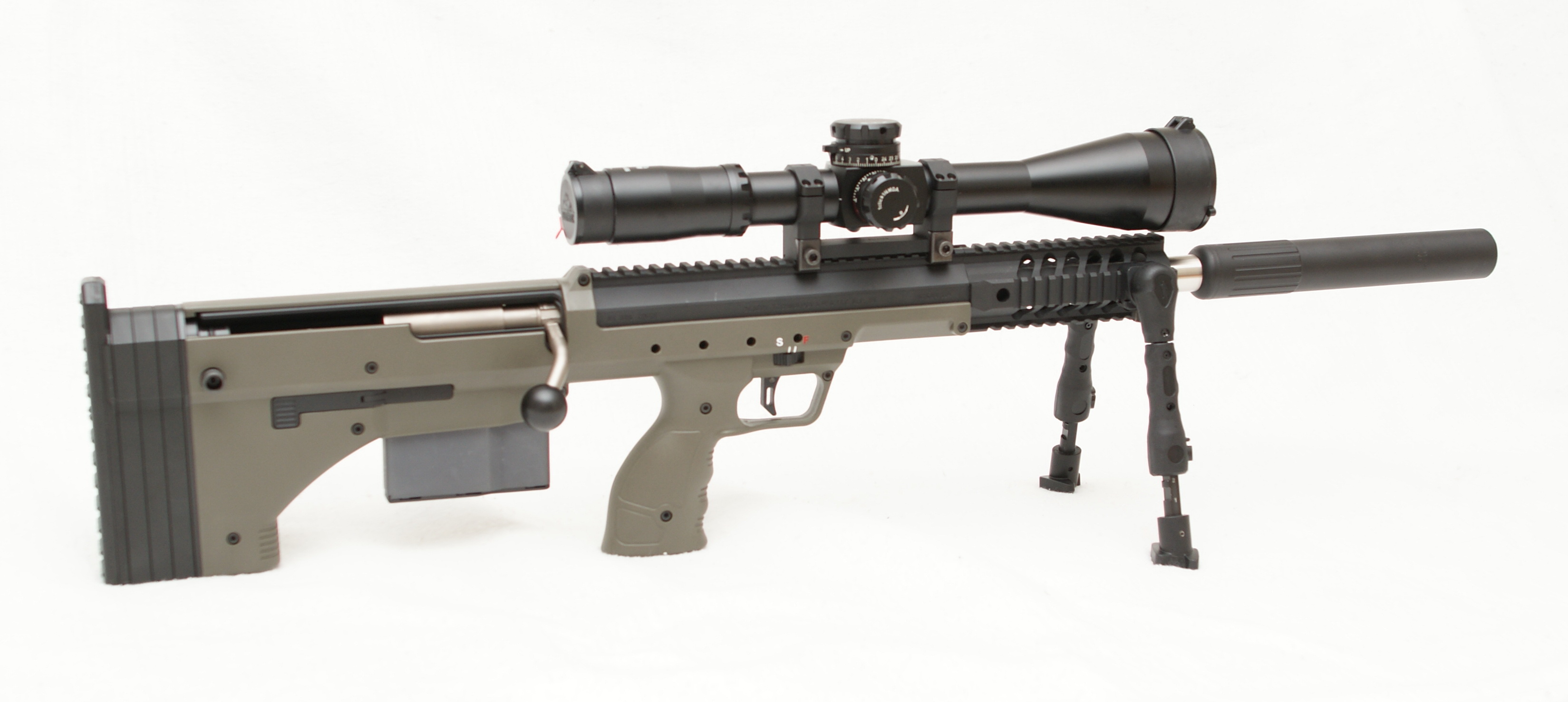
Desert Tactical Arms Stealth Recon Scout Rifle

DTA SRS Covert with IOR and Cyclone

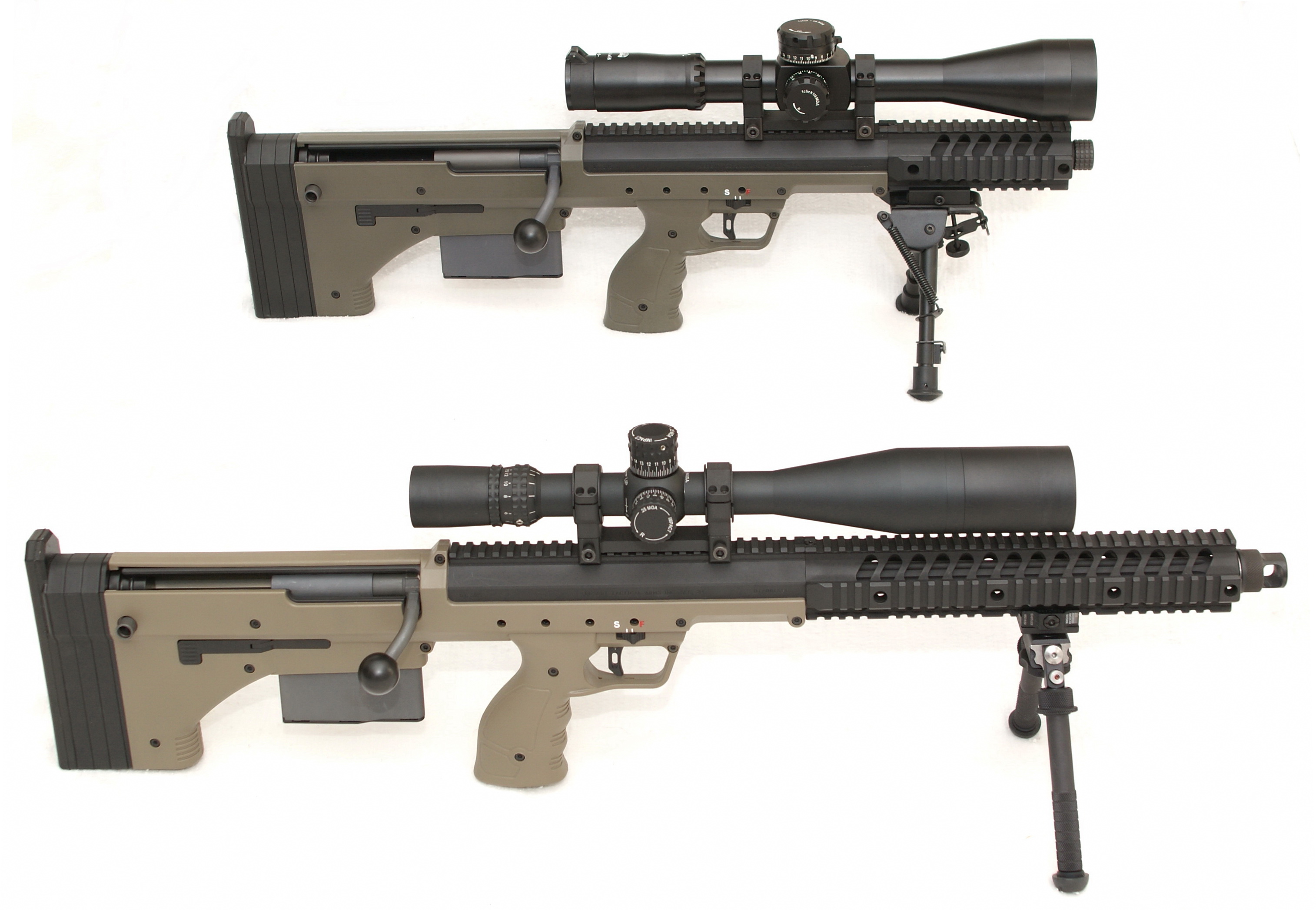
Desert Tactical Arms currently makes the only bolt-action bullpup rifle available in the U.S. Given my love of the bullpup style I was excited to find them, until I saw that their prices start at over $4000. I said, “No way; I’ll wait until someone does it cheaper.” A year went by with no signs of anyone moving to compete in this niche. I did some more research, found a dealer selling them at a 20% discount to retail and, as you can see, finally convinced both myself and a friend to pull the trigger. Pictured here is my SRS Covert (the shorter one) in Olive-Drab Green and my friend’s full-length SRS in Flat Dark Earth.

DTA SRS and SRS Covert
(Of course once you spend $4000 on a rifle you don’t want to cut corners on the scope: Mine carries a $1700 IOR Valdada 6-24x56mm FFP. The other wears a $2200 NightForce 3.5-15×50 FFP.)

The Covert chassis is the bare minimum 26″ in overall length, and is equipped here with a 16″ barrel chambered in .308 with a 1:8 twist — optimal for running subsonic loads as well as the heaviest .308 bullets. The standard SRS has an extended fore-end that pushes it to 32″ long, and is shown here with a 22″ .308 barrel, 1:11 twist.

These rifles are supposed to compete not only in price but also in performance with the finest precision bolt guns on the market: Accuracy International, G.A. Precision, Sako, Surgeon, and higher-end custom sniper rifles.

The DTA SRS has some remarkable features (in addition to the bullpup configuration I love for its compactness):

  1. Quick-change caliber conversion: Using a single torque wrench a barrel can be swapped out in under a minute and replaced without losing zero.  The chassis accommodates conversion bolts and magazines to cover calibers from .243 Win up to .338 Lapua Magnum.
  2. The trigger is the finest I have ever pulled.  It is a single-stage design and is adjustable for creep and weight.  I have mine turned down to 1.5 pounds.  (Granted, I don’t have trigger time on the competition, and many shooters who do claim that Sako and AI triggers are better.  Many also lament the lack of a second stage and adjustable stop.)
  3. All DTA barrels are match-grade Lothar-Walthers.  The rifles have developed a reputation for world-class long-range precision.
  4. Quick-Detach sling mounting points are included everywhere you might want them.

There are some fundamental shortcomings:

  1. The bolt assembly — essentially the only mechanism on the gun that has to move — has a matte finish.  It should have a high-lubricity coating.  I paid ROBAR $65 to coat mine in NP3.
  2. The single-stack magazines are made to very loose tolerances and, given their construction, are absurdly expensive.  DTA charges over $100 for a part that it appears they haven’t spent more than $15 to make.
  3. The butt is hard, and there is no means of adjusting the comb.

Another drawback is that the company is still immature.  I wouldn’t expect sloppiness like the following given the price they are charging:

  1. My barrel arrived with copper fouling.  (Hopefully only “tested,” not “used.” DTA claimed that after test-firing barrels they don’t clean them in case customers want to run the break-in rituals that high-end barrel makers eschew.) [Update: I actually couldn’t get it to shoot under 1.5MOA, and after several range sessions to eliminate any other sources of error returned it. It took them a month, but they finally sent me a new barrel that shoots .5MOA with factory match ammo.]
  2. To date they have included a “test target” with every gun that is just a photocopy of one shot earlier in the year on a different gun and in a different caliber.
  3. They have a few good service agents, but also some very incompetent ones.

Subsonic .22LR Terminal Ballistics and Lethality

.22LR is the smallest firearm cartridge in common use today. Common wisdom holds that it is too weak to use for defense against humans or for hunting any animal larger than a raccoon. However there is some evidence that this cartridge is underestimated.

.22LR ammunition is attractive for several reasons:

As I have noted elsewhere, it is a great round for shooting with suppressors: Because .22LR produces so little propellant pressure and volume, suppressors for the caliber can be made very small and light. Furthermore, there is an abundance of subsonic loads on the market, which allow for nearly silent shooting: When shooting slower loads out of my rifles with an Outback suppressor the only audible sound from the gun is the click of the sear releasing the hammer and striking the cartridge rim. The sound of the lead projectile striking a soft target even a hundred yards away is louder to the shooter. (Note that in moderate weather muzzle velocity has to fall below 1000fps to avoid sonic echoes, which increase in loudness and turn into unmistakable sonic cracks as muzzle velocities cross the speed of sound around 1100fps.)

Guns I have reviewed in this caliber include:

So this is a cheap, fun, and accurate caliber. But is it useful for hunting or defense? This is a subject of endless debate. When it comes to defense, of course, we would prefer to avoid confrontation altogether, and failing that would grab a high-powered rifle or shotgun to stop any aggressor. Smaller guns and lighter rounds are a compromise: you sacrifice power and penetration in order to get something more portable and shootable.

Effects on Humans

Common wisdom has it that .380ACP is “barely” enough bullet to qualify as a defensive handgun round, and anything lighter is more likely to enrage an aggressor than to stop him. My favorite study of this subject is An Alternate Look at Handgun Stopping Power by Greg Ellifritz. He analyzed nearly 1800 shootings during violent encounters and came up with some surprising results:

  1. A lot of the time just shooting at someone is enough to get them to stop, regardless of caliber or whether they are hit. I.e., guns “psychologically stop” many assailants. Based on this observation: It’s more important to have a gun – any gun – than to be caught without one.
  2. Determined aggressors do need to be “physically stopped” (incapacitated), and in that case shot placement is far more important than caliber. I.e., largely regardless of caliber: if you hit an assailant in the head they stop 75% of the time. Torso hits stop them 40% of the time. Put another way: How well you shoot is more important than what you shoot.
  3. However, independent of shot placement, calibers below .380ACP are twice as likely to “fail to incapacitate” as the larger calibers. So yes, there is something to the conventional wisdom that if you’re carrying a gun it should shoot something no smaller than .380ACP.

Continue reading

All plug-in clocks should have capacitor backups

I just bought the Honeywell RPLS740B Econoswitch, a clever dawn/dusk switch that knows when the sun will be down year-round based on the latitude entered during setup. I’m using it to switch on exterior lights at dusk, saving me the trouble of frequently adjusting the set-point of the mechanical switch it replaces.

One feature I particularly appreciate is its use of a super-capacitor to keep time during power interruptions.

Every plug-in device with a clock should have a supercapacitor time backup. Some use batteries as clock backups, but many more — including expensive appliances like my various ovens — have no backup at all. Unlike batteries, capacitors have an unlimited service life: See this whitepaper on “Supercapacitors for RTC and Memory Backup.”

Review: John Carter 3D BluRay

I haven’t been to a movie theater in years, and I don’t intend to go so long as I can reproduce a more comfortable and convenient experience in my basement for a few thousand dollars — which I can with my high-definition, LED-backlit 3-D screen and surround sound system.

Disney sent me an early release of their quarter-billion-dollar production John Carter on 3D BluRay. Rather than add to the whirlwind of full reviews of the movie, I’ll just make one note and a few random critiques:
Continue reading

CLEAR internet — Best small-office internet access alternative

I recently setup a new small office. Because it was a lease in a commercial building the usual ISPs — Comcast and Verizon — would only offer us over-priced, overburdened “business” internet services.

Fortunately I had just come across a new ISP: CLEAR, which provides unlimited broadband using 4G wireless. For $50/month we use their portable wireless access point to serve up to 8 devices at 4G speeds. No contracts, no usage limits, no hassles. It has been working without any hiccups for two months now.

For routine business use I would definitely recommend this over the wired alternatives. Comcast and Verizon Business: You’re on notice!

Primary Weapons Systems PWS T3 Summit Toggle Action .22LR Rifle

Here is a subsonic target rifle I built on PWS’s new T3 Summit rimfire toggle action:
PWS T3 with Hogue stock and Outback II suppressor

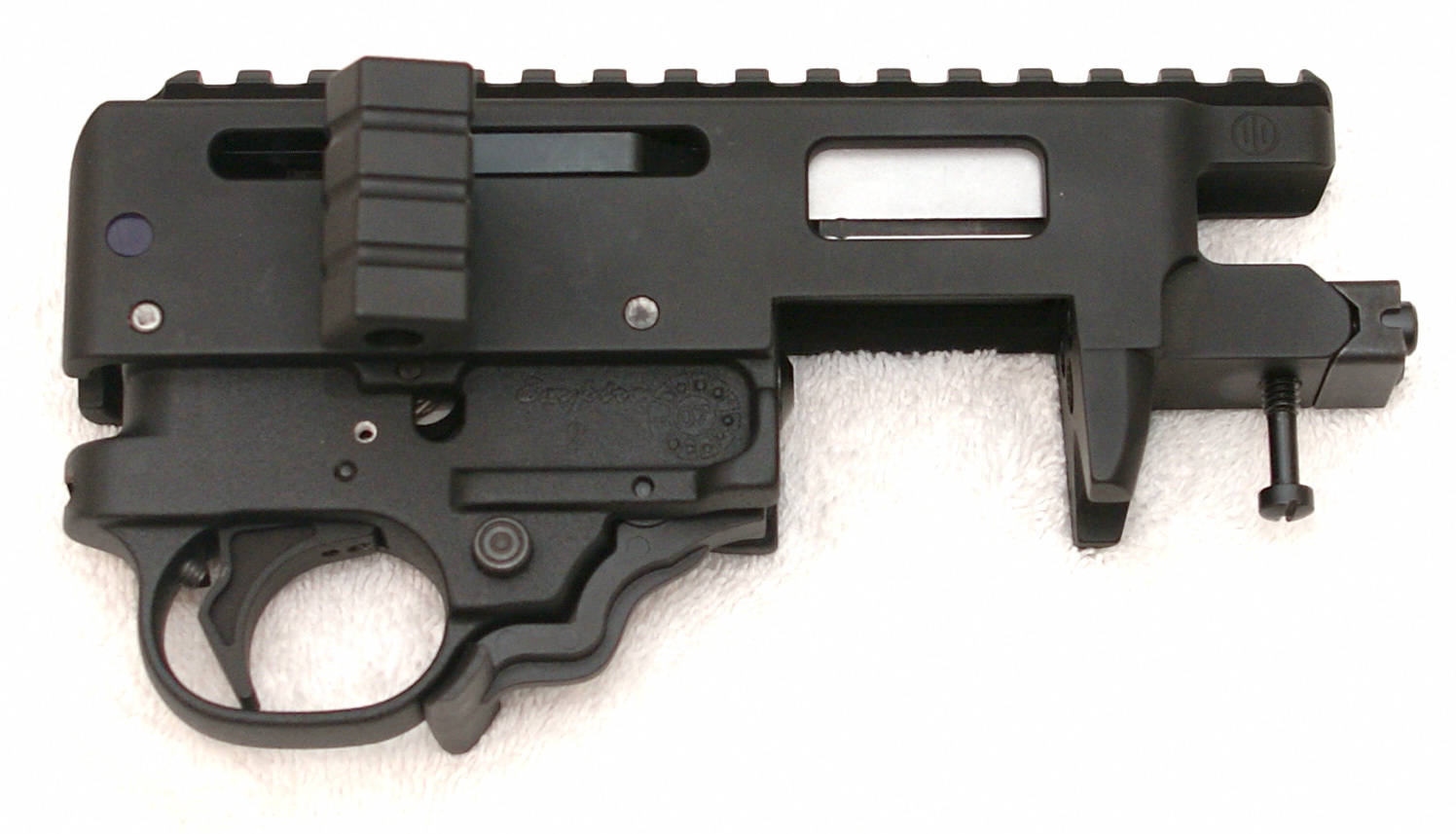
I acquired the T3 receiver and trigger assembly, shown below, for $500. The beautifully machined bolt and receiver are proprietary, but everything else is compatible with the broad market of Ruger 10/22 accessories. The trigger assembly features a crisp 2.5-pound trigger, and is all metal except for the trigger itself and the convenient extended magazine release lever in front of the trigger guard.
PWS T3 receiver and trigger assembly

I installed the receiver in a Hogue stock. The 18″ barrel came muzzle-threaded from EABCO and button rifled with a 1:9 twist rate: sufficient to stabilize subsonic 60gr Aguila .22 bullets. (The standard .22LR twist rate is 1:16.) Those two components brought total cost for the gun to $750, excluding a scope.
Continue reading