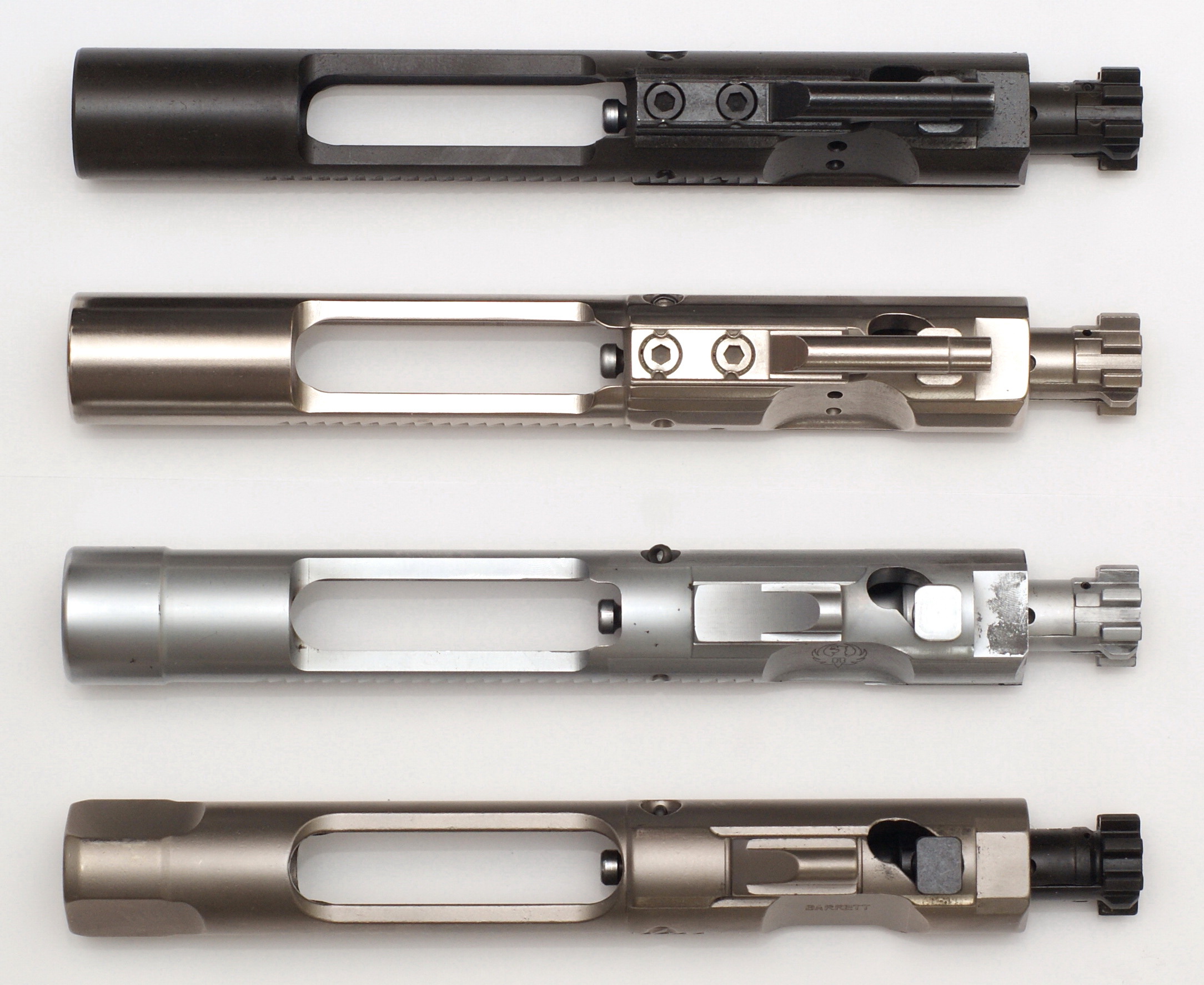
Most firearm action components are made of steel, but they can be given a variety of coatings with remarkable properties. Shown here are four AR-15 bolt-carrier groups (BCGs). From top to bottom they are coated in:
- Phosphate, a.k.a., parkerized
- Nickel-boron, a.k.a. NiB
- Chrome
- Nickel-Teflon, a.k.a. NP3
Phosphate
Phosphated steel has been used in guns for over a century, and is still the military standard for BCGs. The one shown here is from a premium Noveske rifle. I asked Noveske why they don’t use a more modern coating and was told, “Even though the smooth hard coatings take a few seconds less to clean they do not hold oil. Oil keeps the gun running longer and keeps the gun from wearing out. The standard parkerizing holds on to oil longer than any other finish. It keeps the gun running longer.” Indeed, the finish on this BCG is rough and soaks up lubricant like a sponge, though it also seems like a magnet for grit and fouling.
Chrome
Chrome is widely used in barrels and chambers because it is extremely hard, corrosion resistant, and smooth. I’ve run the one shown here from a Ruger SR-556 more than any other single AR-15. It is easier to clean and requires less lubricant than a standard BCG. I suspect it should also be less prone to failures if insufficiently lubricated.
Nickel-Teflon
NP3 is a relatively soft coating of Teflon-impregnated nickel done by ROBAR. Due to its softness it will show wear, but due to its lubricity I am not aware of any instances of it wearing through. It is so slippery that any fouling can be wiped off with a dry rag. The BCG here is from a Barrett Rec7. Wilson Custom also uses NP3 on all their BCGs.
Nickel-boron
The industry leader in NiB coatings for firearms is WMD Guns, which markets the coating as NiB-X, and which spun off from FAILZERO, which markets it as EXO. Shown here is a new $200 mil-spec NiB-X BCG.
Both NP3 and NiB are lubricious enough to run without lubricants. (In fact, like dirt, lubricants can’t really adhere to these electroless nickel-based coatings.) ROBAR claims that NP3 is more consistently lubricious than NiB and significantly more corrosion resistant. NiB is hard enough that you can use steel scrapers and brushes to clean it. However it is not as smooth as NP3 or chrome, so you need a lot more than a cloth to remove the discoloration of carbon fouling that embeds itself in NiB’s microscopic surface irregularities. Granted, that’s a cosmetic issue, not a functional one. It does, however, lend plausibility to a few reports of NiB BCGs jamming up and needing lubricant to unlock.
Continue reading