Monthly Archives: February 2013

The Obsolete .45 ACP

The .45 ACP cartridge has a strange, cult-like devotion among many American handgunners. Strange because it is practically inferior to more modern pistol cartridges. Its diameter makes it impractical for double-stack magazines (which is not to say those don’t exist: I handled FN’s double-stack FNP-45 but it is far too large for a carry gun), which means capacity is typically just 8 rounds for a full-sized gun. The chamber pressure limit for the cartridge is just 21kpsi, vs. 35-40kpsi for more modern pistol cartridges. This may have been a benefit in the past but with the ubiquity of strong alloys and precise manufacturing technologies it is no longer. It does, however, mean that the cartridge is optimized for propelling heavier bullets at slower velocities, which as I explained in a previous post results in more recoil for a given level of energy. Finally, the heavy bullets and larger dimensions of the cartridge make it significantly more expensive than other defensive pistol cartridges.

The .45 ACP was developed and launched along with the 1911 pistol, so even though 1911s are produced for other calibers there seems to be some nostalgia for shooting 1911s chambered in .45 ACP. But there is also a great deal of lore surrounding the prowess of the cartridge as a “man-stopper.” This is almost certainly rooted in the military’s experience with pistols. The U.S. has followed the 1899 Hague Convention, which prohibits the use of hollow-point bullets in warfare. Until 2010 even military police carried full metal jacket pistol loads. Rifle bullets go fast enough that standard copper jackets break up in soft tissue, creating large wound channels and dumping most of their energy into human targets. But slow, solid handgun bullets punch through human targets practically intact, which means that they leave a wound channel only as wide as the bullet itself. Given this constraint it’s not surprising that .45s developed a reputation for stopping people with fewer shots than smaller bullets that have been government issued.

But this situation does not apply to civilians, who can carry hollow-point bullets. The standard test for terminal ballistic performance is to shoot gelatin that is calibrated to the consistency of animal tissue. The following image shows the wound channel and penetration of standard loads using jacketed hollow-point (JHP) bullets:
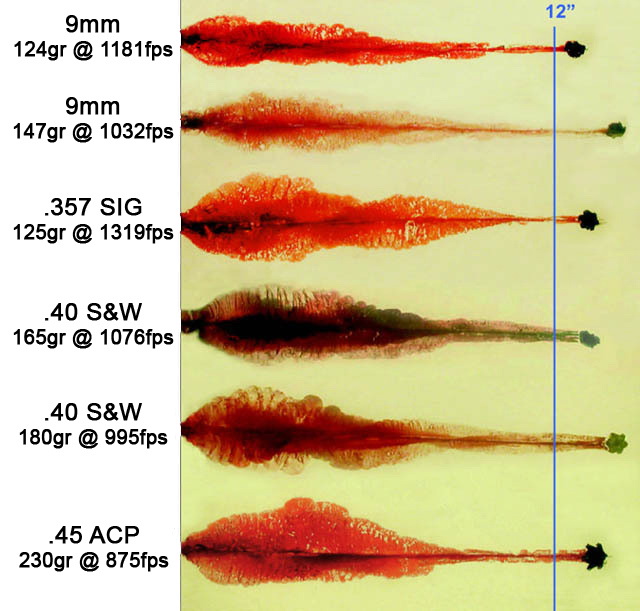
Ballistic gel tests of hollow-point pistol rounds

With hollow-point bullets the .45 ACP offers no advantage in stopping power over .40 S&W or .357 SIG (my favorite), which have the advantages of lower recoil, lower cost, and higher magazine capacities.

Energy and Recoil for the pistol rounds shown in the ballistic gel image above
Caliber Bullet
Mass
Muzzle
Velocity
Muzzle
Energy
Power
Factor
Relative
Energy
Relative
Recoil
9mm 124gr 1181fps 384ft-lbs 146 1.10x 1x
9mm 147gr 1032fps 348ft-lbs 152 1x 1.04x
.357 SIG 125gr 1319fps 483ft-lbs 165 1.39x 1.13x
.40 S&W 165gr 1076fps 424ft-lbs 178 1.22x 1.21x
.40 S&W 180gr 995fps 396ft-lbs 179 1.14x 1.22x
.45 ACP 230gr 875fps 391ft-lbs 201 1.12x 1.37x

One obvious question is why no .45 cartridge has been specified with higher pressure limits? For example, raising peak pressure to 32kpsi could add 200fps to the load shown here, boosting both Relative Energy and Relative Recoil to 1.7x. One obstacle may be the popularity of 1911 .45s: Neither a standard 1911 nor a standard .45 ACP case can safely support much higher pressures. A few wildcat cartridges have emerged over the years (e.g., .45 Super and .450 SMC) with the same external dimensions and higher pressures, but SAAMI will probably not approve any such cartridges because they could be inadvertently fired in a .45 ACP gun, causing damage and potentially catastrophic failure. SAAMI did approve the .45 Win Mag because its slightly longer cases wouldn’t chamber in a .45 ACP. However that caliber never really caught on, perhaps due to the other problem: power factors above 250 represent a level of recoil that is apparently not practical for a defensive carry pistol.

I recommend this page for further reading on terminal ballistics.

1911-style Pistols

Sig Nightmare, Springfield TRP, Carry Nightmare, P220 Combat

Shown here are four autoloading pistols chambered for the .45 ACP cartridge. Three are incarnations of the 1911, and bottom right is one alternative I consider superior to that design: The Sig P220 (this one a “Combat” edition with an extra $150 of anti-corrosion coatings). On the left are Sig Sauer’s $1200 Nightmare and Nightmare Carry variants of the 1911. Top right is the Springfield TRP, a near custom-grade 1911 that costs almost $1800.

John Browning’s 1911 pistol is a historic firearm, made even more remarkable by the fact that the century-old design is still considered competitive with the most modern handguns on the market. It is not uncommon to see custom-tuned 1911s selling for $2000-$3000. The high end of the custom 1911 market exceeds $5000. I will admit that a hand-finished 1911 can be a beautiful machine: a reliable, durable, precise pleasure to shoot.

But I find a few drawbacks to the 1911. The first is that you have to really pay up to get a 1911 that equals the fit and finish of the $1000 P220 I show for comparison. (See my praise of the Sig Sauer P22x series here.) Even these more expensive Sig Nightmares exhibited out-of-the-box stickiness in trigger pull and operation that left me feeling like they needed to be cleaned and polished, or maybe more broken in. The Springfield TRP, on the other hand, provided the slick, transparent handling I have only briefly experienced with other (even more expensive) custom 1911s.
Continue reading

I Like Sig Pistols

My top choice for autoloading pistols are Glocks. However when money is not a dominant factor I have become enamored of Sig Sauer pistols. (With night sights they start around $1000, vs $600 for Glocks.)

Sig P226 German, P229R Elite Dark, P226 Scorpion, M11-A1

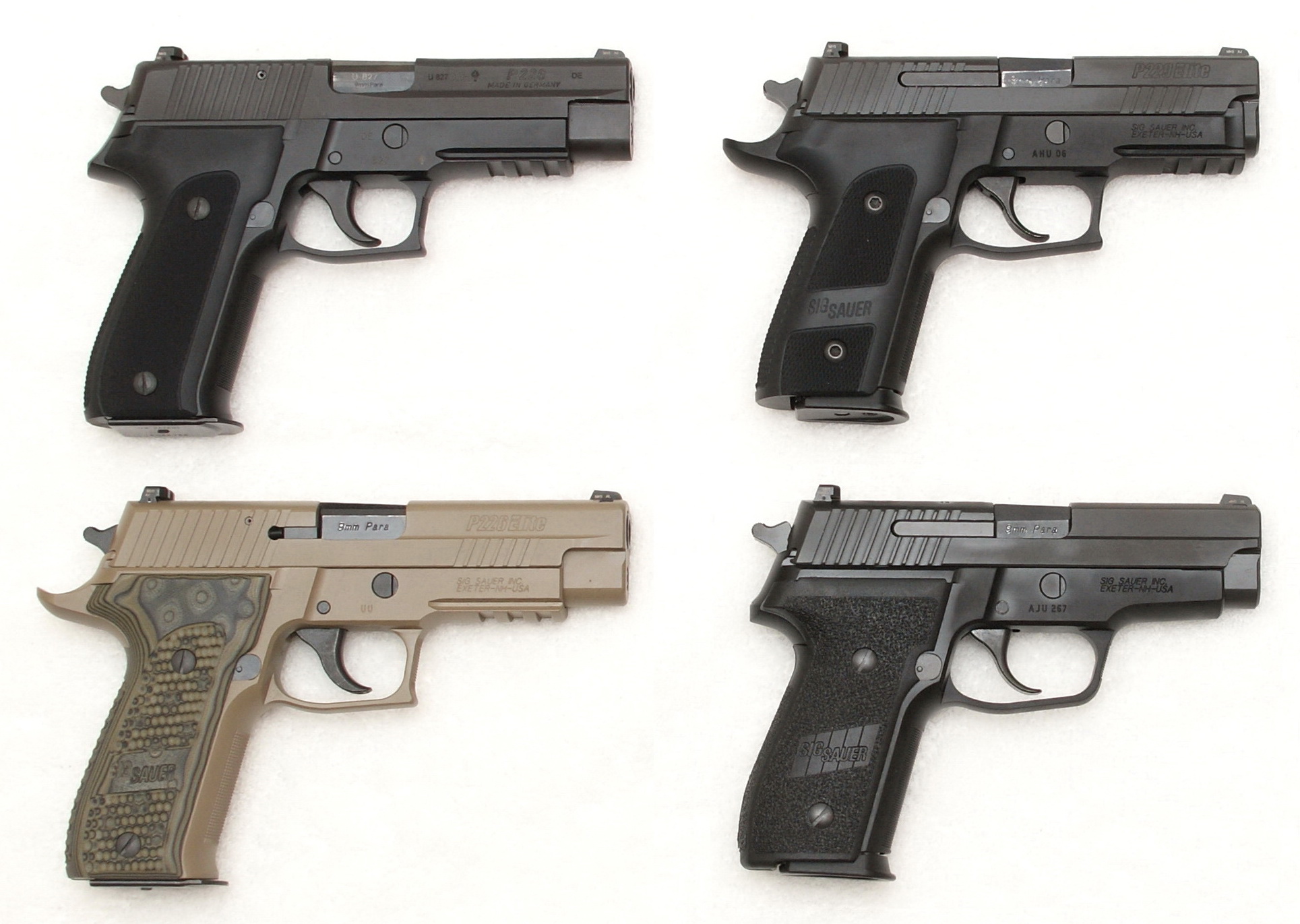
Shown here are four classic DA/SA pistols chambered in 9mm (but also available in .357 SIG and .40 S&W). On the left are the full-sized P226 German and P226 Scorpion, with standard 9mm magazine capacities of 15 rounds. On the right are the mid-sized P229 Elite Dark and M11-A1, with 9mm magazine capacities of 13 rounds. All have SIGLITE night sights.

Top Left: The P226 German is hard to find here since Sig has been making pistols for the U.S. market at its Exeter, New Hampshire facility for years. Apparently the German plant uses some different methods to manufacture the slide. Practically I can’t see any differences with a standard P226. This specimen also features Hogue anodized aluminum grips, which are my personal favorite.

Top Right: The P229 Elite Dark adds a beavertail frame, SRT trigger, Hogue aluminum grips, and front cocking serrations to a regular P229.

Bottom Left: The P226 Scorpion is a P226 Elite finished in Flat Dark Earth. Grips are Hogue G10.

Bottom Right: The M11-A1 is a P229 built for the military. It features the Sig Anti-Snag (SAS) frame and phosphate-coated internal parts to increase corrosion resistance.

The common attractions of this line of pistols are the following:

  • They are available with Sig’s Short Reset Trigger (SRT), the best factory pistol trigger I have ever tried.
  • Their metal frames and slides fit and run like a fine watch. Trigger aside, there’s something sublime about the feel and finish that sets them in a class above guns with polymer frames and triggers.
  • They have no manual safety, which I consider an unnecessary complication in a defensive pistol.
  • Reliability is top-notch, as their numerous contracts with the most demanding government buyers attest.

I went into the DA/SA trigger system in detail in my recent post on the Sig P239. To summarize: The pistol is carried loaded and decocked. The first trigger pull is a long but smooth ten-pound double-action that first cocks and then releases the hammer. The DA trigger pull is the pistol’s “manual safety,” which can also be “disengaged” by manually cocking the hammer. From that point until the pistol is manually decocked the trigger has a precise 4-pound break with minimal overtravel and reset.

Physics of Gun Energy, Recoil, and Range

Yesterday’s post highlighted one gun cartridge (the .357 SIG) that, in small pistols, delivers energy disproportionate to its recoil. Today I will describe more generally the physics and practical considerations that go into optimizing a gun for a particular purpose.

The purpose of a gun is generally to project some combination of Energy, Range, and Accuracy.

Today this is done with firearms, which are subject to practical constraints on Length, Cartridge Size, Chamber Pressure, Rifling, and Recoil. Cartridge Size is a function of propellant (gun powder) capacity and projectile (bullet) size. To understand the physics that relate all these variables we will actually start with a Cartridge and work backwards, because:

A. Propellant volume puts an upper limit on the Kinetic Energy a gun can generate.

Continue reading

Sig P239 Pistols

The P239 is the sub-compact variant of Sig Sauer’s classic full-power autoloading pistol, making it a great deep concealment or backup gun.

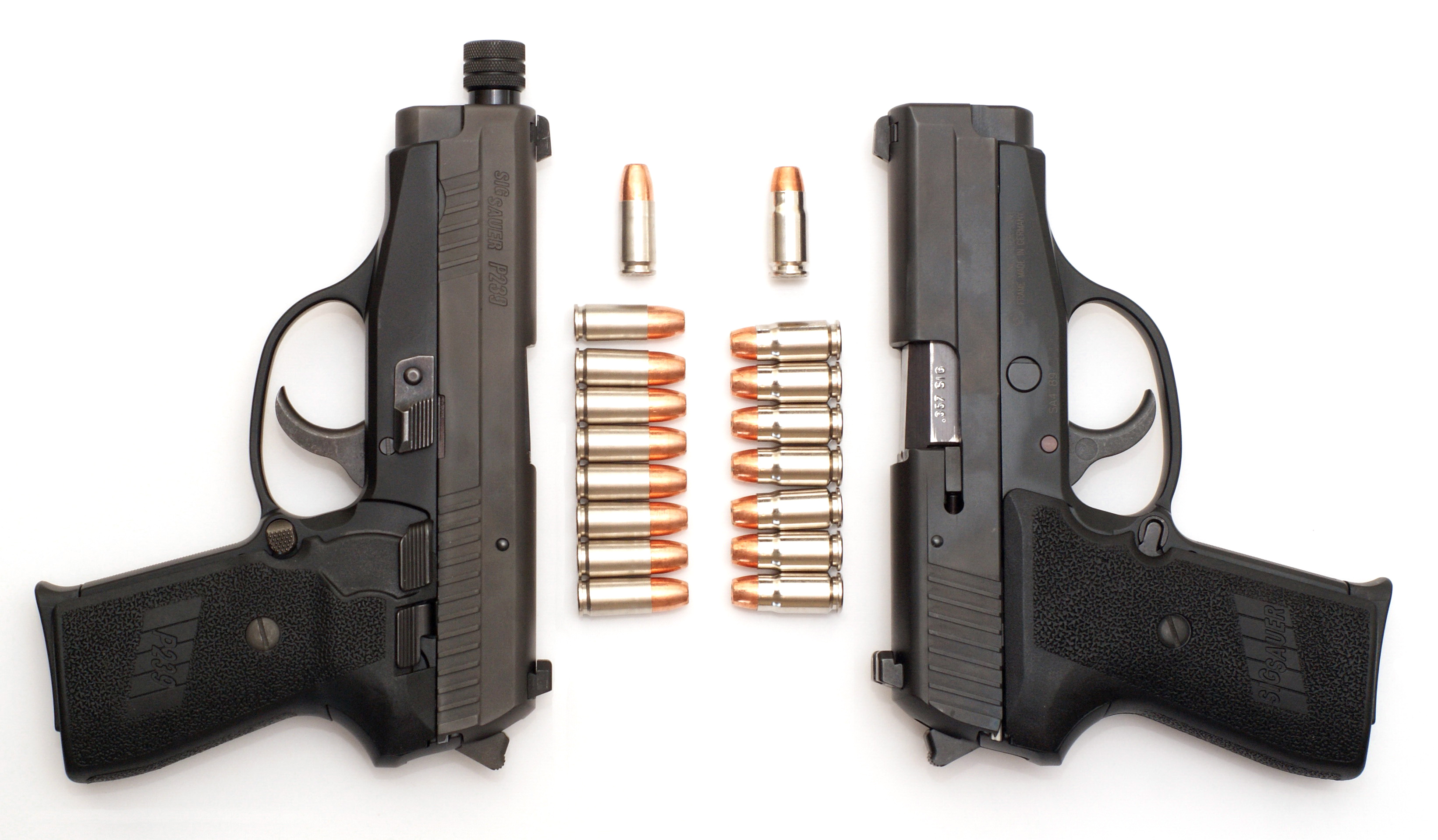
Sig P239s in 9mm and .357 SIG

On the right is a ten-year-old standard P239. On the left is a recent “Tactical” variant, which includes front serrations on the slide and Sig’s Short-Reset Trigger (SRT). This one also has an extended barrel threaded for a suppressor, which increases the barrel length from 3.5″ to 4″. Both pistols are equipped with SIGLITE night sights. (Illuminated sights are essential for any pistol that might need to be used in low-light conditions, as defensive arms so often are.)

Calibers

The P239 is available in 9mm, .357 SIG, and .40 S&W. The left pistol is chambered in 9mm, allowing it to carry 8+1 rounds vs 7+1 in the pistol on the right, which is shown in .357 SIG. Switching calibers is only a matter of changing the barrel and recoil spring, and putting in the correct magazine.

.357 SIG, though not as popular as the other two calibers, is uniquely appealing. A typical defensive load for the 9mm is a 125gr bullet. Loaded to +P specifications it will leave a 3.5″ barrel at about 1200fps. The .357 SIG fires the same bullet at 1400fps. A typical .40 load is either a 150gr bullet that reaches 1200fps or a 180gr that attains 1000fps.

Many of the arguments over defensive calibers are anecdotal, and in that domain people who have to shoot a lot of animals consider the .357 SIG to be a more reliable stopper than the slower alternatives here. Higher velocity also seems to offer some resistance to deflection and assistance to barrier penetration, though the nuances vary largely with the bullets and materials being shot. Nevertheless, there are two objective metrics that everyone agrees on: (1) Kinetic Energy, which determines the maximum amount of damage a bullet can do, and (2) Momentum, which is proportional to recoil, which determines how difficult it is for a shooter to control the gun and make accurate follow-up shots. While Energy continues to be quoted in foot-pounds, the shooting industry has adopted a measure of momentum called “Power Factor,” which we will use here:

Load Velocity (fps) Energy (ft-lbs) Power Factor
9mm+P 125gr 1200 400 150
.357 SIG 125gr 1400 544 175
.40 150gr 1200 480 180
.40 180gr 1000 400 180

The .357 SIG is a clear standout for a short-barreled pistol like the P239: Of the available calibers it offers the highest velocity and energy without exceptional recoil. However, it is not as widely available as the other two calibers. Also, 9mm is significantly cheaper and can squeeze one more round into each magazine. If I were on a budget and wanted to do a lot of practice I would probably use 9mm at the range and switch the gun back to .357 SIG for protection.

Triggers

Sigs are fine pistols. The examples here cost about $1000 each. The fit, finish, operation, and reliability of these guns are superb.

The classic Sig Double-Action/Single-Action (DA/SA) trigger system offers some unique features. These pistols are designed to be carried with the hammer down. In that condition the first pull of the trigger is a long and heavy (about ten pounds) double-action that serves to cock and then release the hammer. After the first shot the hammer is cocked and the trigger performs the single action of releasing the hammer (with just over four pounds of pressure). When the shooting is over the decocking lever (second on the left side) lowers the hammer, rendering the gun safe to holster. I.e., the gun’s “manual safety” is the double-action trigger pull. That “safety” can also be disengaged by manually cocking the hammer when the gun is first drawn.

The single-action trigger pull and reset are superb. The standard trigger takes about half an inch to reset. From there it is slack until pulled back to the sear release point, where it breaks and stops crisply. The SRT, standard on the Tactical and an easy $50 upgrade on any other model, takes the trigger to a level I previously thought existed only on custom-tuned 1911s: The SRT resets in little more than an eighth of an inch, and there is no discernible slack after the reset. This allows a shooter with a properly disciplined trigger finger (i.e., one that doesn’t unnecessarily release or jerk the trigger) to fire shot strings with only minimal finger movement.