Posts

Autumn Equinox

I happened to be in Salt Lake City during the equinox, where I learned that Utah has outlawed a lot of things. One random example: Happy Hour. Probably Utah also prohibits human sacrifices during equinox celebrations – I didn’t even bother to ask.

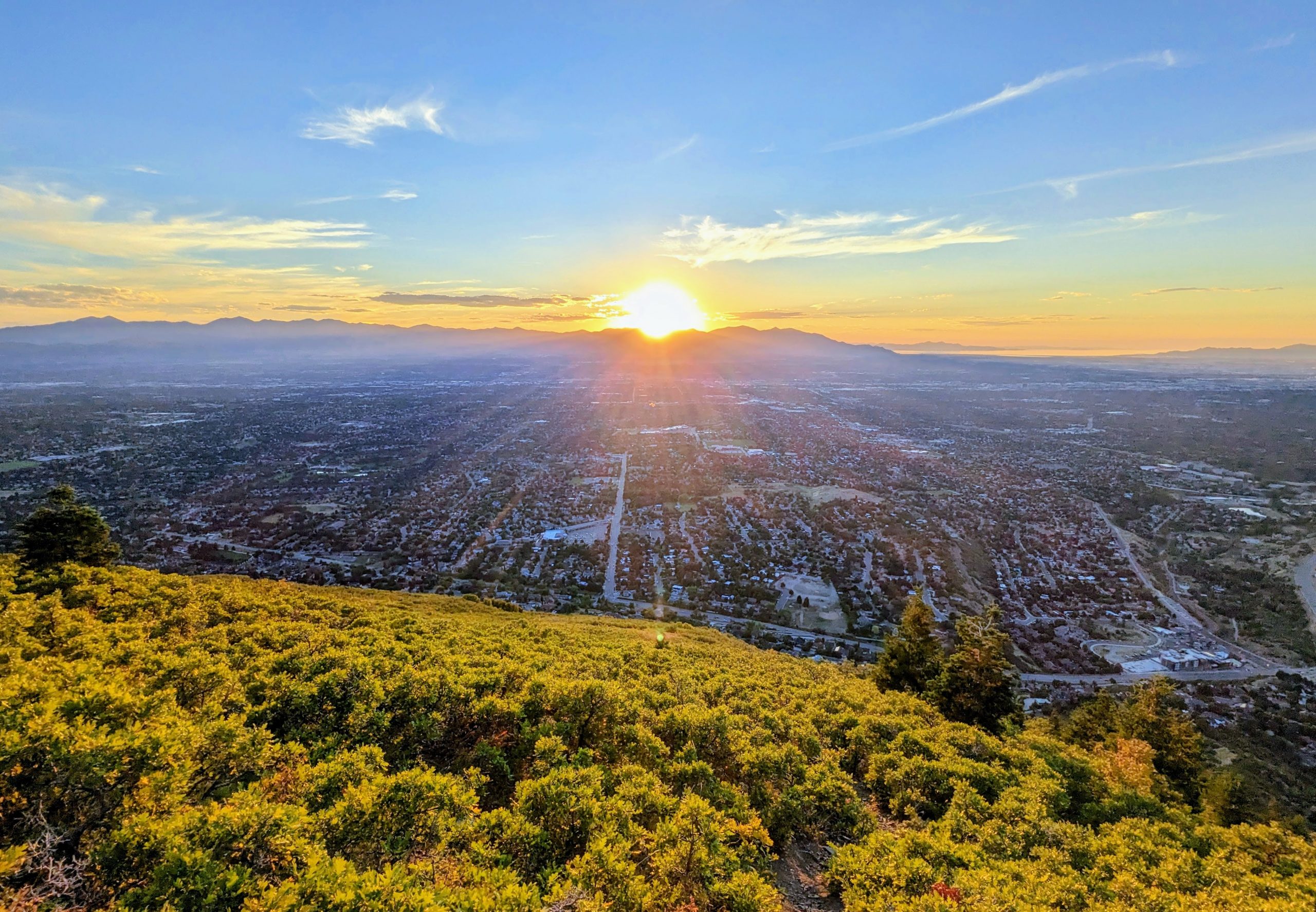
So aside from weird rules what else is there in Salt Lake City? Mountains. As my many readers know, I love to photograph interesting celestial events. So I went for a hike to get this equinox sunset:

Salt Lake City autumn equinox, 7500′ ASL

These foothills can be deceptive. I parked at one between the Big and Little Cottonwood Canyons and began to climb straight towards a peak. The first few hundred feet was fine gravel, so I had to kind of scamper from weed to weed to avoid sinking and sliding back. Then I reached sturdier ground which supports thickets of shrub-like oak trees. Those obstruct the view of what’s above, so I couldn’t be certain whether I had a good path ahead. I did eventually run into a trail bearing human footprints (though I saw no one else the entire hike). The trail wound back and forth between rocks and trees, and it was still very strenuous: When I got back I checked a topographic map and found that the straight-line route I followed from 5500 to 7500 feet averaged a 45 degree slope!

Breakfast

Here is my new favorite breakfast: A chocolate protein smoothie with banana, peanut butter, almond milk, and cold-brew coffee concentrate.

For more than two decades previous my breakfast was half a box of Post’s Great Grains Raisins Dates Pecans. Every few weeks drug stores would put that cereal on sale and I would buy every box on the shelf. (Before COVID sale prices would be $2.50/box. 5+ years ago $2/box. $1.50/box before that, and 20 years ago the (Air Force) base commissary would often sell them for $1/box!) Keeping a stock of more than 60 boxes was not uncommon. Here’s a typical view of my pantry:

My custom is to steep cereal in milk for a few minutes until it gets a little soft. I used to use skim cow’s milk, but some years ago I developed a lactose sensitivity and switched to almond or oat milk.

There was an interlude about 20 years ago after I bought a batch of this cereal that was infested with moths. That took away my appetite for it for a few years, during which I switched primarily to General Mills’ Basic 4 cereal.

In college and earlier my appetite was enormous: In dining halls I would fill my tray with 4-6 bowls of cereal (granted, dining hall bowls aren’t very big), leading people to jokingly suggest that I switch to Total cereal. Total is just boring cereal that General Mills mixes with extra multivitamins. For many years they ran commercials like this showing how many bowls of competing cereals it would take to accumulate those extra vitamins:

Perseid Meteors

Perseid Meteors, composite image by David Bookstaber
Perseid meteors. That’s Jupiter near the middle of the frame.

I set up my old Sony A77II with an intervalometer for an hour and managed to capture these Perseid meteors. I was using my widest lens, 16mm, shooting ISO 1600 with 10 second exposures. It took some real work to post-process and compose this image: I had to find the frames with meteors and stack and align them in Photoshop. The result is nothing great for several reasons, including that (a) meteor shower photos should use a wider lens, and (b) should include a horizon or some ground feature for perspective.

It’s easier to get better results using a smartphone, not only because a typical smartphone has a very wide lens, but also because software can take care of identifying frames that contain meteors and aligning them. After the fact I checked the app store and found at least one cheap app that does this with a built-in “Meteor Mode.”

Bullies and Mismatched Senders

As described in Malcom Gladwell’s book Taking to Strangers, a strong body of research has revealed that many people have mannerisms that are incorrectly interpreted by others. The academic literature refers to such people as “mismatched senders,” because their non-verbal communication does not match what they intend to communicate. Or rather, to place the blame where it belongs: Many people erroneously think that they can deduce things from non-verbal communication, and mismatched senders are the victims of that error.

I am a mismatched sender. I have often been told this by people who become acquainted with me. Apparently my bearing superficially suggests an arrogance that really isn’t there. I am prone to smile or laugh when I am nervous or confused. Et cetera. Unless you have read Gladwell’s book, you might be surprised at the problems this can create.

I have also been a target of bullies my whole life. Physical bullying mostly stopped when I became dangerous: At age 12 I gave two bullies black eyes and that was the end of that. There was no payoff to psychological bullying because I didn’t have many friends and didn’t seem to care.

But I’m still an attractive target to people who are looking for somebody to take down a notch.

Father Birds: Killdeer

Killdeer are common birds of the plover family (like the mourning doves I showed in a previous post). Their name supposedly comes from their loud and distinctive call, which bird guides say sounds like “kill-deer,” though I don’t hear that at all. There’s a video of one at the bottom of this post so you can hear and judge for yourself. As with mourning doves, both parents stay to incubate and protect the eggs, which take 3-4 weeks to hatch. Killdeer chicks are precocial, meaning that they can walk and feed themselves soon after hatching. The parents still tend to them and protect them from danger. They learn to fly when they are about 3 weeks old.

Following is a gallery of photos I took of killdeer I found nesting in my yard. I was alerted to their presence by the antics of the mating pair protecting their four eggs. First was a persistent and attention-grabbing tweet. Once my eye found one of the parents, the bird began its famous “broken-wing” act, which is used to lure predators away from their nests: the killdeer will pretend to have an injured wing, dragging it and beating it against the ground while making pitiful cries. The idea is that a predator will follow the seemingly easy prey as the killdeer leads it further and further away from the nest. When the predator is far enough, the killdeer fly away. This actually makes it easy to find the nest: Just go in the opposite direction of where the killdeer is drawing you. The closer you get the to its nest the closer the killdeer will come to you in an attempt to distract you.

So I did find and photograph their eggs, but I didn’t want to overly traumatize the birds so I returned with my 300mm lens to get these photos from a reasonable distance.

The eggs are sort of camouflaged, but leaving them in a clutch like that on open ground still doesn’t seem to me like a great strategy.

Killdeer doing its “broken wing” distraction dance and cry.

Father Birds: Doves

Mourning doves are one of the most common and widespread birds in North America. They get their name from the distinctive (and incessant) cooing sound they make. Male mourning doves are also devoted and protective fathers. In honor of Father’s Day, here are some photos of both parents caring for a fledgling.

Once a pair of mourning doves mates, they usually stay together for life. They work together to build a nest, usually on a tree branch or a ledge. The nest is made of twigs, grasses, and leaves, and is often flimsy and loosely constructed. The female lays two eggs at a time, which are incubated by both parents for about two weeks. The father usually takes the day shift sitting on the eggs.

After the eggs hatch, both parents feed the chicks “crop milk,” which is a thick mix of protein and fat they secrete in their crops (a part of the esophagus where they store seeds) and regurgitate for their chicks to eat out of their mouth.

Mother mourning dove feeding fledgling

The chicks grow to near full size and fledge in just two weeks! In these photos the fledglings are almost as big as their parents and will leave the nest in a few days.

Yale Course Critique (A Brief History)

Spring cleaning my paper files I found copies of the Yale Course Critique from when I was an undergraduate in the 1990s. I wrote for that publication, served as a department coordinator, and was a senior editor 1998-1999.

The Yale Course Critique was a student production, affiliated with the Yale Herald. At the end of each semester, volunteers collected paper surveys and, for those courses with sufficient responses, aggregated ratings and summarized feedback in a 3-4 paragraph blurb. We printed a few thousand copies (sponsored by ads) and distribute them in dining halls at the beginning of each semester when students were trying to figure out which of the ~1,000 available Yale University courses to enroll in.

When I first encountered the Yale Course Critique I knew this was my kind of project: Collecting and disseminating data to help improve peoples’ ability to make important choices? And the university didn’t support this? Sign me up!

But why, I wondered out loud, wasn’t the University itself doing this? Most professors and departments distributed survey forms to students at the end of the semester. Only some agreed to share those with the Yale Course Critique. For those that didn’t, we had to solicit student feedback separately – in dining halls, and even posting volunteers outside the larger lectures to distribute and collect our survey forms from students.

I became a crusader for the cause. First as a “department coordinator” I tried (with some success) to convince individual professors and department heads to voluntarily share their surveys with us. As a senior editor I aggressively lobbied leaders in the Yale College Faculty to make sharing survey data a university policy. We did not succeed in that before I graduated in 1999, but I just spent some time researching this and found that by April 2002 the (student) Yale College Council passed a resolution requesting the university to “create a comprehensive online course critique,” and by November 2002 the Yale College Faculty unanimously agreed.

There has been some subsequent intrigue: By 2014 Yale College, now in full control of the data, tried to limit its use. They threatened students who summarized it on a separate website. In response to that another enterprising student, Sean Haufler, wrote a browser app that produced the summaries directly in client browsers.

I couldn’t find much history of the Course Critique. There is mention of one in 1969. Another shows up in 1985 with a note that none had been published since 1982. The “Yale College Course Critique” I joined appears to have been revived in 1993: The hardcopies in my archive show Volume 3(#2) dated September 1996, through Volume 6(#1) dated January 1999. Not much was captured online. Here are are few pages from fall issues in 1996, 1997, and 1998:

Hummingbirds

The word for hummingbird in most other European languages is colibri. I can’t find an explanation for why English didn’t adopt that. I put out a feeder with a 1:4 solution of sugar : water, and once they find it hummingbirds come for a drink every 15 minutes for the entire day. Here are photos of one frequent visitor:

Sometimes they perch, and sometimes they maintain a hover while drinking. They get a little territorial about the feeder, even though it has four perches and flowers to drink from: when one hummingbird is at the feeder, often another will approach and provoke it and they’ll flit away rapidly spiraling around each other.

Hummingbird species encompass not only the smallest birds but also the smallest warm-blooded animals. During the day they maintain the highest metabolism of any vertebrate. This requires a nearly constant supply of sugar. (At night, when they can’t feed, they perch and enter a hibernation-like state of vastly reduced metabolism called torpor.)

In terms of flying skills, they can keep their head perfectly still in a hover, even as their wings are fluttering back and forth dozens of times a second. I have seen them hovering at the feeder in the heavy winds preceding a thunderstorm. In the morning and evening I can see hummingbirds hovering and swooping to eat tiny flying insects.

No other vertebrates can maintain a true hover in flight, and the size range for hummingbirds runs from 2g to 20g. This suggests that any smaller and an endoskeleton and/or homeothermic metabolism becomes too expensive for a hovering animal. Any heavier and it becomes too difficult for a biological system to process and supply the energy needed to hover.