Standardization of products and specifications is invaluable to market efficiency. For example, a standard “letter”-sized sheet of paper will fit in a standard binder or a standard envelope. It is sold in “reams” of 500, making it easy to compare prices. It can be used in almost any printer or scanner. Imagine if each paper company manufactured proprietary paper dimensions to increase the likelihood that only their paper handling accessories could keep their paper organized?
Mechanical fasteners tend to be standardized. A small set of screwdrivers is sufficient to adjust most screws. What if you had to go to the manufacturer to buy a special set of tools for every product you wanted to repair?
Common languages, formats, and specifications are the backbone of the digital economy, just as standardized shipping containers, roads, and vehicles are the backbone of our physical markets.
Unfortunately there are incentives for producers to secure rents by avoiding standards. Inkjet printer manufacturers have proliferated proprietary ink cartridges in order to inhibit competition for replacements. For years these manufacturers have been practically giving away printers in anticipation of the profits they will make selling proprietary ink cartridges. The same manufacturers now offer “tank”-based inkjet printers that cost more to buy but much less to refill with ink.
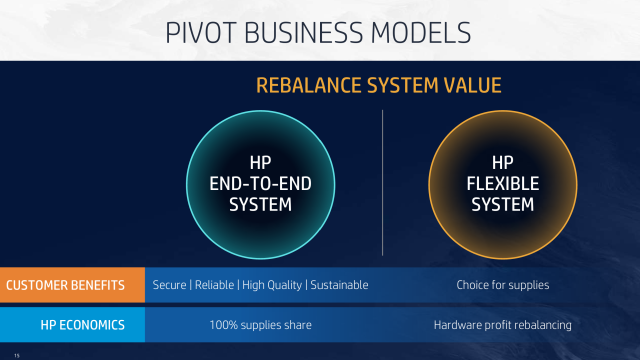
HP has been candid about the economics of its business. In a 2019 presentation to securities analysts it identified the objective of its “end-to-end” business model as “100% supplies share.” (This is the “give away the printer and make money selling ink” approach.)
In a subsequent 2020 presentation to investors, filed with the SEC in the course of fending off a hostile takeover by Xerox, HP revealed that 25% of its customers take the printers and somehow don’t buy HP ink. Hence the second “Flexible System” business, in which the printers are sold at a profit so it doesn’t matter whether the ink comes from HP.

There need not be anything economically inefficient about offering consumers a choice between paying more upfront and paying more over the life of a product. But consider the resources expended in designing, manufacturing, and stocking the myriad of proprietary ink cartridges. And consider how much less printing some consumers do because of the high cost of ink. This is not efficient.
There are often good engineering reasons for a manufacturer to develop a specialized component. But there can also be a financial incentive to create a proprietary component that only it can economically manufacture instead of using a standardized component that performs the same function but that is broadly and competitively produced. To the extent that manufacturers introduce incompatibilities merely to insulate themselves from competition, we forgo the economies of scale (in both production and use) that would otherwise result from standardization.
What market forces resist proprietary incompatibility? The after-market web of complementary products, component suppliers, and repair businesses should push towards standards. To the extent that consumers can detect and incorporate the costs of incompatibility into their purchasing decisions, they will penalize manufacturers for unjustified specialization. But consumers are ill-equipped to analyze a product for specialized components, determine where specialization was justified, or estimate the added costs attributable to specialization over the life of the product.
What market forces promote standardization? There are considerable incentives for producers to adopt standards where doing so reduces their own costs or expands their markets. Entire industries have successfully collaborated to develop standards. But there is an upfront cost to be borne in defining standards, and much of the benefit of both defining and adopting a standard may accrue to parties other than those bearing the cost. An openly published standard is a public good, and its value to society generally increases with the extent of its adoption.
So do we need the coercive hand of government to promote standardization to ensure the good functioning of markets? It certainly can help: A 2022 European Union Directive mandated USB-C charging ports for a range of consumer electronics – over the objections of industry heavyweight Apple. Note that the industry had already succeeded in developing the standard. What it hadn’t succeeded in doing was getting all of its major participants to adopt it. (Children today may never know the tangled stores of unique charging and connecting cables that electronics users had to keep on hand in the before times.)
Of course there is also a danger in mandating standards: How much harder is it to introduce a superior technology once the incumbent technology has not only swept the market but even been codified in law? Where possible it would seem preferable to standardize the interfaces between products rather than the products themselves.
This is not just about physical goods. Standardization has even come up in the domain of consumer finance markets. The promotion of “plain-vanilla” consumer finance products can produce more efficient markets by making it easier for consumers to comparison shop and harder for producers to stuff extra profit into complicated products. Mortgages are a great example. Conforming 30-year mortgages – themselves largely a product of government-sponsored institutions – make it relatively easy to spot competitive sellers. But even today you have to go to some lengths to filter out the noise of points and “upfront costs.” Government-mandated standardized disclosures help consumers do that without restricting the types of mortgages that lenders can offer.
There is an interesting question here for free-market advocates. The efficiency of competitive markets depends to a great extent on the ability of consumers to substitute one producer’s product for another’s. Yet individual producers can profit by frustrating that process. To the extent that government can facilitate such substitution without inhibiting useful innovation, its intervention should make markets more efficient.
One thought on “Standardization is a public good. Should government promote it?”