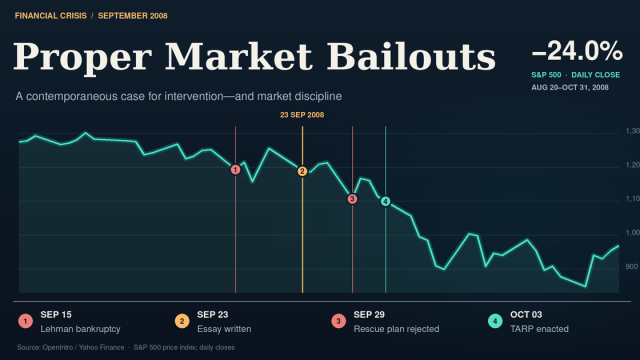
I wrote this September 23, 2008 – in the middle of the Financial Crisis. Posting here as a contemporaneous perspective.
Last week, U.S. capital markets were in unprecedented distress and were on the verge of locking up, imperiling both the U.S. economy and world markets. Over the past year, excessive leverage throughout the markets began to unwind as market participants realized that many assets were worth less than they had previously believed. This gradual unwind became critical last week when it began to happen too fast for market participants to react in an orderly fashion.
In the normal course of events, capital markets are like a nuclear reactor, pooling capital and risk to create heat that powers the economy. Without the concentration and free exchange of capital and risk, no heat is generated, and economic development is stagnant. However, the same leverage and risk exchange that fuel the economy can produce critical conditions that can spiral into a systemic meltdown. Meltdowns can be provoked by systemic fraud and bad government regulation, of which the massive government-sponsored mortgage debacle was a prime example.
Whatever the root causes, the U.S. markets were undergoing a protracted delevering that began to look like a meltdown. Until recently, private sources of capital had always stepped up to halt such crises by buying distressed assets and institutions at deep discounts. But last week, the unwind became so fast and widespread that no private entity could intervene: so many market entities and normally low-risk assets were caught in the unwind that there was simply not enough leverage and liquidity in private hands to stop it.
This is a painful and difficult thing for us free-market adherents to acknowledge. We may very well be able to pin some of the blame on past government interference in the markets. But we can now see how large-scale fraud and mismanagement can cause markets to fail in a catastrophically contagious way – one that threatens the daily business of regular people and companies that depend on modest debt financing or the lowest-risk assets.
Is a government-sponsored bailout justified in such circumstances? I am inclined to believe so, just as the government should have the ability to issue gobs of debt to jump-start a defensive war for survival (as in WWII, for example). When assets cannot find buyers even at distressed levels, and when this market failure will trigger a meltdown, the government should be able to buy distressed assets at a discount. When contracts and their counterparties that are essential to the operation of the capital markets are in danger, and when their failure will exacerbate a meltdown, the government should be able to backstop those contracts.
Many conservative writers are appalled at the bailout proposed by the U.S. Treasury, and for many good reasons. It is fraught with moral hazard, and it risks increasing the ongoing involvement of government in markets. Therefore, a proper government-sponsored market bailout should adhere to the following principles:
1. Anyone who stood to gain from a risky position should ultimately bear the maximum possible loss if that position is bailed out. For example, equity holders in bailed-out GSEs and banks should lose all their equity. Debt holders should also be charged for losses that are not recouped. Bailouts can provide liquidity to halt the vicious cycle of selling, but ultimately, losses need to be borne by the market participants, not taxpayers.
2. Anyone who participated in fraud should be prosecuted. This would include mortgage brokers and debtors who lied, and brokers and underwriters who misrepresented the liquidity of auction-rate securities.
3. The government intervention should be strictly temporary.
4. Government liquidity should ultimately make a profit for the taxpayers. Liquidity should always be able to earn excess returns in free markets. When the government steps in to buy assets and contracts in a crisis, it should do so at a steep discount. It can afford to hold those assets for as long as necessary, but its ultimate goal should be to cash out those assets or return them to the market – at a profit.
One thought on “Proper Market Bailouts (2008)”