My post on Moral Hazard in Asset Management reminded me of a great paper by Foster & Young (“Gaming Performance Fees by Portfolio Managers,” QJE 2010). They showed that if an asset manager can sell options1 then it is impossible to distinguish skill from luck based on a manager’s track record. In fact, if – as is often the case – managers are compensated for positive track records, then there is a glaring incentive for unskilled managers to compete for assets by taking hidden risks.
What’s the problem? Let’s start with the traditional hedge fund pitch: A skilled manager finds a way to produce alpha – for the purposes of this post, alpha can be described as profits beyond what can be earned from passive exposure to market investments. Call the legitimately skilled manager a “Maker” of alpha.2 Whatever alpha a Maker produces can be mimicked using skewed contracts that have no alpha. An unskilled “Mimic” manager can create the appearance of alpha by tucking offsetting risk in a tail of his return distribution. And you can too, using this little Mimic calculator:
How a stellar track record can hide a cliff
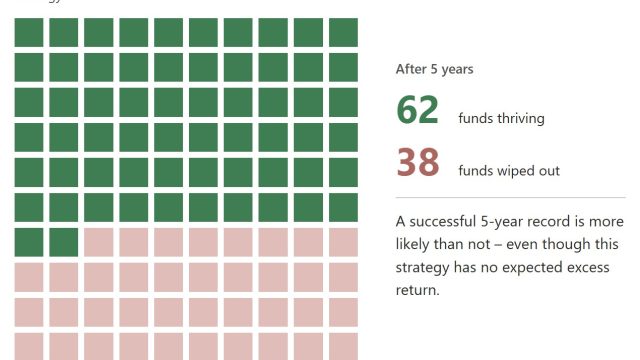
Here we model 100 Mimics who use a simple gamble to produce the appearance of skill.
Pick the annual return to mimic, then dial the length of the track record to see how many unskilled Mimics would stay in business at least that long.
Expected excess return: 0%. Annual probability of total loss:
Each square represents one Mimic fund following the same strategy.
After 5 years
A successful 5-year record is more likely than not – even though this strategy has no expected excess return.
How does the expected excess return stay at zero?
For an excess annual return of 10.0% in a successful year, the annual chance of a total loss is 9.1%. The two numbers are linked so the usual gains exactly offset the rare loss:
loss chance = gain / (1 + gain) (1 − loss chance) × (1 + gain) = 1The chance of succeeding for 5 years is 62.1%.
How could an option create this payoff?
In an idealized, zero-interest example, start with $1, sell a one-year cash-or-nothing put whose payoff is $1.1000 if a specified event occurs. If the put expires worthless, the stake becomes $1.1000; if it pays, the stake becomes $0. (To fund this at a $1 starting cost, the put must fetch $0.09091 per $1 of contingent payoff.)
Since a hedge fund manager typically sells alpha (i.e., excess returns), the benchmark rate of return cancels out of the equations underlying this model.
A deliberately simple strategy: each path either gains steadily or suffers a total loss. It assumes independent loss events, and event options that trade at their expected value with no transaction costs.
As this toy example shows, each Mimic stands a decent chance of thriving for years without a positive expected return. Just rolling the dice.3 Investors only meet the survivors, and the surviving Mimics collect management fees the whole time.
Mimics need not be malicious. They could instead be naive or incompetent. An example: Early crypto investors who milked arbitrage opportunities that looked like risk-free money … only if they didn’t account for counterparty risk.
Alpha need not exist. In theory we know that as markets increase in efficiency, scalable alpha decreases. In practice we know that alpha tends to evaporate: There are a lot of smart and motivated people looking for alpha, so the first person to find a source is never going to be the last, and as more people discover it the alpha is either driven to zero or it becomes beta.4
Solve for the equilibrium: The supply of alpha is limited, transient, and unknown. The supply of capital looking for alpha is effectively all of it. If somebody claims that they will sell alpha to an outsider, the first question I ask is, “Why?”5 In the limit, a manager with real alpha can demand to keep virtually all of it because there is so much money chasing alpha.
What if investors avoid managers who can trade high-skew contracts? This does help, and industry regulators have long tried to prevent retail funds from holding – or at least concealing – “speculative” risks like those needed to mimic alpha. That reduces the magnitude of the problem even though it doesn’t eliminate it. Retail investors are notorious for chasing historical performance. And any active manager can benefit from luck instead of skill to beat his benchmark by a few points and win significant assets in the process.
How do sophisticated investors address the Mimic problem? They try to make mimicry more difficult by demanding more transparency and manager oversight. A stellar track record can attract attention, but prospective managers need to back it up with a strategy that can explain it and audits that show their activity is consistent with their disclosures. Fee design alone can’t do it: Foster & Young’s paper shows that postponing bonuses and clawing them back – the fix I proposed in Moral Hazard – will not stop Mimics unless it comes with transparency into managers’ positions and strategies. Is it alpha or is it luck? The track record alone can’t tell you.
- To be precise: a sufficient condition is access to contracts with highly skewed payoffs. ↩︎
- Alpha is worth paying for, and there are any number of ways skilled managers can generate returns on capital that are uncorrelated to the market and that have attractive expected return characteristics – arbitrage; market making; astutely harvesting market premiums on liquidity, information, and risk. The problem Foster & Young rigorously demonstrate is that a “mimic” can sell options to create a negatively skewed stream of returns that, with high probability, is hard to distinguish from alpha … until it suffers a catastrophic loss. ↩︎
- There is some hand-waving going on here, but not much: In practice the risk/return utility function is not flat, and tail risks tend to command a risk premium, so the Mimic may earn a risk premium. But that premium falls out of the equation by definition when we put things in alpha terms: no manager skill is needed to collect a risk premium that is available passively. ↩︎
- If competition for an alpha source doesn’t drive it to zero, then competition will turn it into beta. For example: 50 years ago a fund manager who bought stocks that were fundamentally cheap or had strong relative performance did in fact produce alpha. Today there are strong arguments that those factors are fully priced into the market (i.e., the alpha went to zero), but if you disagree then you can buy those factors in ETF form almost for free (i.e., it has become beta). ↩︎
- There can be good answers, but they depend on details out of scope here. ↩︎
Wow, who knew? Great analysis